


Page 94 - EER-2-3
P. 94
Explora: Environment
            and Resource                                    Comparative analysis of THMs and THAAs in water distribution media


              According to Clark et al.,  there are four main strategies   and membrane technology, are well-known but cannot be
                                  28
            for controlling DBPs and microbial contaminants in   considered as cost-effective or sustainable when compared
            drinking water: biological filtration, conventional filtration,   to sand filtration media, granular activated carbon (GAC),
            membrane  technology, and coagulation.  Chaukura   or even the adsorbing filter made from banana peels
            et al.  further identified  effective  methods for DBP   studied in Jahin  et al.  Moreover, multiple studies have
                                                                                 5
                29
            removal, including adsorption, air stripping, ozonation,   shown that sand filtration and GAC play a significant role
            chlorination, enhanced coagulation, membrane filtration,   in the removal of  NOM, a  known precursor of DBPs.
                                                                                                             6
            and advanced oxidation processes. In general, Jiang et al.    Specifically, carbon-based adsorbents have been shown
                                                         10
            categorized DBP control into three major strategies:   to significantly reduce emerging contaminants in water.
                                                                                                            38
            source control, the use of alternative disinfectants, and   To the best of our knowledge, no comparative study has
            precursor removal. Source control includes implementing   examined the formation and removal of major DBPs in
            environmental management policies or replacing chlorine   relation to the cost-effective treatment of water distributed
            with alternative disinfectants such as chloramines or   through galvanized iron (GI) and HDPE pipes.
            chlorine dioxide, although these alternatives can still pose   This study was conducted in District Mardan
            health risks. Due to its low cost, simplicity, and minimal   (geographic  coordinates:  34°05’N–34°32’N  and
            energy requirements, sand filtration is widely used in   71º48’E–72°25’E), one of the central districts of Khyber
            drinking  water  treatment.  Similarly,  ultrafiltration  has   Pakhtunkhwa (KP) Province, Pakistan. The study area was
            been recognized as a promising technique. However,   divided into three zones based on groundwater hydrology:
            the removal efficiency of ultrafiltration depends on the   an urbanized/industrial zone (Shergarh and Takhtbhai)
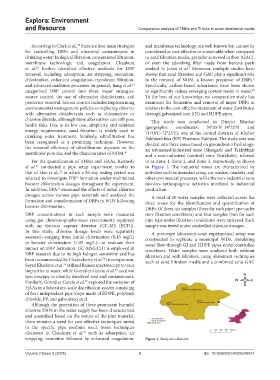
            membrane pore size and the characteristics of NOM. 30  and a non-industrial (control) zone (Surkhabi), referred
              For the quantification of THMs and HAAs, Kennedy   to as Zone 1, Zone 2, and Zone 3, respectively, as shown
            et al.  conducted a pipe setup experiment similar  to   in  Figure  1.  The industrial  zones  are  characterized by
                31
            that of Liao et al.,  in which a 56-day testing period was   activities such as manufacturing, car washes, markets, and
                          32
            selected to investigate DBP formation under maintained   other commercial processes, while the non-industrial zone
            booster chlorination dosages throughout the experiment.   involves anthropogenic activities unrelated to industrial
            In addition, EPA  examined the effects of initial chlorine   production.
                         33
            dosages  across  various  pipe  materials  and  analyzed  the   A total of 10 water samples were collected across the
            formation and transformation of DBPs in WDS following   three  zones  for  the  identification  and  quantification  of
            booster chlorination.                              DBPs. Of these, six samples (three for each pipe type under
            DBP concentrations in each sample were measured    non-filtration conditions) and four samples (two for each
            using gas chromatography-mass spectrometry equipped   pipe type under filtration conditions) were analyzed. Each
            with an electron capture detector (GC-MS [ECD]).   sample was tested under controlled chlorine dosages.
            In this study, chlorine dosage levels were separately   A  prototype  laboratory-scale  experimental  setup  was
            assessed—ranging from initial chlorination (0.43  mg/L)   constructed to  replicate  a municipal  WDS, simulating
            to booster chlorination (1.03  mg/L)—to evaluate their   water flow through GI and HDPE pipes under controlled
            impact on DBP formation. GC-MS(ECD) is employed in   conditions. Water samples were analyzed both without
            DBP research due to its high halogen sensitivity and has   filtration and with filtration, using abatement techniques
            been recommended by Chakraborty et al.  In comparison,   such as sand filtration media and a combined sand-GAC
                                             34
            Seyed Khademi et al.  utilized Raman spectroscopy to trace
                            35
            impurities in water, while González García et al.  used ion
                                                  37
            spectroscopy to identify dissolved ions and contaminants.
            Similarly, González García et al.  explored the variation of
                                     37
            HAAs in a laboratory-scale distribution system consisting
            of four independent pipe loops made of HDPE, polyvinyl
            chloride, PP, and galvanized steel.
              Although the generation of these prominent harmful
            chlorine DBPs in the water supply has been characterized
            and quantified based on the nature of the pipe material,
            there remains a need for cost-effective techniques suited
            to the specific pipe medium used. Some techniques
            discussed in Chaukura  et al.  such as adsorption, air
                                    29
            stripping, ozonation followed by enhanced coagulation,   Figure 1. Study area division

            Volume 2 Issue 3 (2025)                         3                           doi: 10.36922/EER025240047

