


Page 97 - EER-2-3
P. 97
Explora: Environment
            and Resource                                    Comparative analysis of THMs and THAAs in water distribution media


            Technologies, United States of America). A  fused silica   water distribution network model and observed the
            capillary DB-1 column (30 m × 0.32 mm inner diameter ×   corresponding variations in DBP formation at different
            0.25 µm film thickness) was used. Helium (99.99% purity)   controlled chlorine dosages.
            served as the carrier gas, and nitrogen (99.99%) was used   In this study, the fractions of DBPs detected in water
            as the makeup gas. The analytical operating conditions are   samples from Zone 1, Zone 2, and Zone 3 varied. Key
            summarized in Table S1.                            psychochemical characteristics contributing to DBP
              Standard internal peak areas were used to prepare the   formation were identified for each sample. The analysis was
            calibration standards. A  linear regression equation was   carried out in phases, beginning with a dosage of 0.2 mg/L,
            applied to generate the calibration curve and calculate   followed by 1.8 mg/L, and finally 2.4 mg/L, applied to both
            the concentration in the extract (C extract ), as shown in   pipe materials.
            Equation II. After obtaining C extract , the concentration in   At the initial chlorine dosage of 0.2 mg/L, the results
            the water sample (C water ) was determined using Equation   (Figure S1) show no detectable levels of THMs and THAAs
            III, based on the sample and extract volumes. Finally, both   in the chromatograms for both pipe types (Figure S2).
            values were inserted into Equation I to calculate the total   Other chlorine-related compounds with chromatographic
            concentration of chlorine DBPs, with full equation details   retention are identified and listed in Table S2. The absence
            provided in the Supplementary File.                of THMs and THAAs may be attributed to the very low
            TTHMs + THAAs = Prominent chlorine DBPs    (I)     residual chlorine concentration, which is likely insufficient
                                                               to initiate significant DBP formation.
                       Measured peak area
            C                                mb   (II)      A chlorine dosage of 1.8 mg/L was applied to the Zone 2
              extract
                   Peak area of internal standard
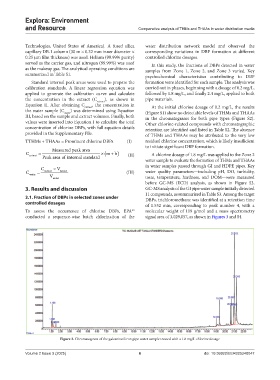
                                                               water sample to evaluate the formation of THMs and THAAs
                                                               in water samples passed through GI and HDPE pipes. Key
                  C      V
            C      extract  extract                   (III)   water quality parameters—including pH, DO, turbidity,
              water
                      V
                       water                                   taste,  temperature, hardness, and DOM—were measured
                                                               before  GC-MS (ECD) analysis, as  shown  in  Figure  S3.
            3. Results and discussion                          GC-MS analysis of the GI pipe water sample initially detected
                                                               11 compounds, as summarized in Table S3. Among the target
            3.1. Fraction of DBPs in selected zones under      DBPs, trichloromethane was identified at a retention time
            controlled dosages                                 of  1.532  min,  corresponding  to  peak  number  4,  with  a
            To assess the occurrence of chlorine DBPs, EPA     molecular  weight of 119  g/mol and a mass spectrometry
                                                         33
            conducted a  sequence-wise batch chlorination  of  the   signal area of 3,029,057, as shown in Figures 3 and S4.


                           Figure 3. Chromatogram of the galvanized iron pipe water sample treated with a 1.8 mg/L chlorine dosage


            Volume 2 Issue 3 (2025)                         6                           doi: 10.36922/EER025240047

