


Page 100 - EER-2-3
P. 100
Explora: Environment
            and Resource                                    Comparative analysis of THMs and THAAs in water distribution media


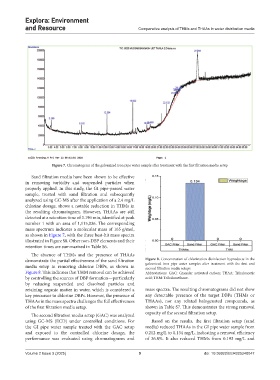
                       Figure 7. Chromatogram of the galvanized iron pipe water sample after treatment with the first filtration media setup

              Sand filtration media have been shown to be effective
            in removing turbidity and suspended particles when
            properly applied. In this study, the GI pipe-passed water
            sample, treated with sand filtration and subsequently
            analyzed using GC-MS after the application of a 2.4 mg/L
            chlorine dosage, shows a notable reduction in THMs in
            the resulting chromatogram. However, THAAs are still
            detected at a retention time of 3.196 min, identified at peak
            number 1 with an area of 1,115,036. The corresponding
            mass spectrum indicates a molecular mass of 165 g/mol,
            as shown in Figure 7, with the three best-hit mass spectra
            illustrated in Figure S8. Other non-DBP elements and their
            retention times are summarized in Table S6.
              The absence of THMs and the presence of THAAs
            demonstrate the partial effectiveness of the sand filtration   Figure 8. Concentration of chlorination disinfection byproducts in the
            media setup in removing chlorine DBPs, as shown in   galvanized iron pipe water samples after treatment with the first and
                                                               second filtration media setups
            Figure 8. This indicates that THM removal can be achieved   Abbreviations: GAC: Granular activated carbon; THAA: Trihaloacetic
            by controlling the sources of DBP formation—particularly   acid; THM: Trihalomethane.
            by reducing suspended and dissolved particles and
            retaining organic matter in water, which is considered a   mass spectra. The resulting chromatograms did not show
            key precursor to chlorine DBPs. However, the presence of   any detectable presence of the target DBPs (THMs or
            THAAs in the mass spectra challenges the full effectiveness   THAAs), nor any related halogenated compounds, as
            of the first filtration media setup.               shown in Table S7. This demonstrates the strong removal
              The second filtration media setup (GAC) was analyzed   capacity of the second filtration setup.
            using GC-MS (ECD) under controlled conditions. For   Based on the results, the first filtration setup (sand
            the GI pipe water sample treated with the GAC setup   media) reduced THAAs in the GI pipe water sample from
            and exposed to the controlled chlorine dosage, the   0.212 mg/L to 0.134 mg/L, indicating a removal efficiency
            performance was evaluated using chromatograms and   of 36.8%. It also reduced THMs from 0.193  mg/L and


            Volume 2 Issue 3 (2025)                         9                           doi: 10.36922/EER025240047

