


Page 99 - EER-2-3
P. 99
Explora: Environment
            and Resource                                    Comparative analysis of THMs and THAAs in water distribution media


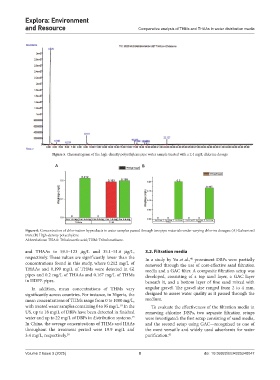
                       Figure 5. Chromatogram of the high-density polyethylene pipe water sample treated with a 2.4 mg/L chlorine dosage

                         A                                   B


            Figure 6. Concentration of chlorination byproducts in water samples passed through two pipe materials under varying chlorine dosages: (A) Galvanized
            iron; (B) High-density polyethylene
            Abbreviations: THAA: Trihaloacetic acid; THM: Trihalomethane.

            and THAAs  to  59.5–123  µg/L  and 35.1–51.6  µg/L,   3.2. Filtration media
            respectively. These values are significantly lower than the   In a study by Yu et al.,  prominent DBPs were partially
                                                                                  40
            concentrations found in this study, where 0.212 mg/L of   removed through the use of cost-effective sand filtration
            THAAs  and  0.199  mg/L  of  THMs  were  detected  in  GI   media and a GAC filter. A composite filtration setup was
            pipes and 0.2 mg/L of THAAs and 0.167 mg/L of THMs   developed,  consisting  of  a  top  sand  layer,  a  GAC  layer
            in HDPE pipes.                                     beneath it, and a bottom layer of fine sand mixed with
              In  addition,  mean concentrations  of  THMs  vary   angular gravel. The gravel size ranged from 2 to 4  mm,
            significantly across countries. For instance, in Nigeria, the   designed to assess water quality as it passed through the
            mean concentrations of THMs range from 0 to 1000 mg/L,   medium.
            with treated water samples containing 0 to 95 mg/L.  In the   To evaluate the effectiveness of the filtration media in
                                                    18
            US, up to 18 mg/L of DBPs have been detected in finished   removing chlorine DBPs, two separate filtration setups
            water and up to 22 mg/L of DBPs in distribution systems.    were investigated: the first setup consisting of sand media,
                                                         19
            In China, the average concentrations of THMs and HAAs   and the second setup using GAC—recognized as one of
            throughout the treatment period were 19.9  mg/L and   the most versatile and widely used adsorbents for water
            3.4 mg/L, respectively. 20                         purification. 41


            Volume 2 Issue 3 (2025)                         8                           doi: 10.36922/EER025240047

