


Page 101 - EER-2-3
P. 101
Explora: Environment
            and Resource                                    Comparative analysis of THMs and THAAs in water distribution media


            0.199 mg/L to negligible levels, indicating an approximate   3.3. Comparison
            removal efficiency of 99%. The second filtration setup   From a comparative perspective on the formation of DBPs
            (GAC media) achieved an estimated 99% removal of both   in water samples passed through GI and HDPE pipes, it was
            THMs and THAAs, thereby demonstrating its superior   observed that in the GI pipe water samples, approximately
            performance.
                                                               0.212  mg/L of THAAs and 0.199  mg/L of THMs were
              In the HDPE pipe, water samples from Zone 3 were   detected under a chlorine dosage of 2.4  mg/L, while
            analyzed after passing through both the first (sand media)   approximately 0.193 mg/L of THMs were detected under
            and second (GAC media) filtration setups. Based on   a chlorine dosage of 1.8 mg/L in a controlled environment.
            the obtained chromatograms, no prominent chlorine
            DBPs—or    related  halogenated  compounds—were      Similarly, in the HDPE pipe water sample, under a
            detected. The absence of THMs and THAAs after filtration   chlorine dosage of 2.4 mg/L, approximately 0.2 mg/L of
            demonstrates the combined effectiveness of the pipe   THAAs and 0.167  mg/L of THMs were detected. These
            material and the filtration media in reducing precursors,   results  indicate  that  lower  chlorine  dosages  resulted  in
            including dissolved and suspended organic particles. This   lower concentrations of chlorine DBPs. With a 33% increase
            highlights adsorption-based filtration as a cost-effective   in chlorine dosage, THAAs in the GI pipe water sample
            abatement strategy. Both filtration setups successfully   increased to 0.212 mg/L, and THMs increased by 3.11%,
            reduced the initially identified 0.2  mg/L of THAAs to   while a comparable trend was observed in the HDPE pipe
            negligible levels, indicating a high removal capacity for   water samples. This pattern supports the hypothesis that an
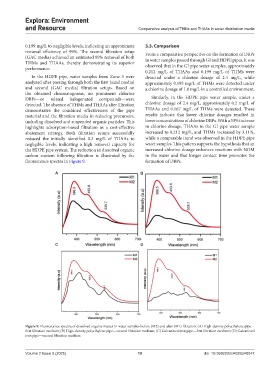
            the HDPE pipe system. The reduction in dissolved organic   increased chlorine dosage enhances reactions with NOM
            carbon  content  following  filtration  is  illustrated  by  the   in the water and that longer contact time promotes the
            fluorescence spectra in Figure 9.                  formation of DBPs.

                         A                                   B


                         C                                   D


            Figure 9. Fluorescence spectra of dissolved organic matter in water samples before (M2) and after (M1) filtration: (A) High-density polyethylene pipe—
            first filtration medium; (B) High-density polyethylene pipe—second filtration medium; (C) Galvanized iron pipe—first filtration medium; (D) Galvanized
            iron pipe—second filtration medium


            Volume 2 Issue 3 (2025)                         10                          doi: 10.36922/EER025240047

