


Page 98 - EER-2-3
P. 98
Explora: Environment
            and Resource                                    Comparative analysis of THMs and THAAs in water distribution media


              Since gas chromatography separates compounds based   the corresponding water quality parameters presented in
            on their volatility, trichloromethane—a small and volatile   Figure S5.
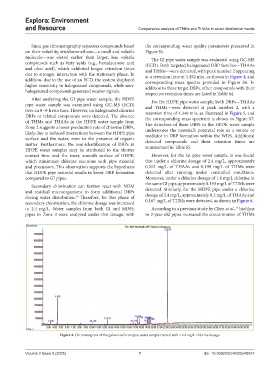
            molecule—was eluted earlier  than  larger, less volatile   The GI pipe water sample was evaluated using GC-MS
            compounds such as fatty acids (e.g., hexadecenoic acid   (ECD). Both targeted halogenated DBP families—THAAs
            and oleic acid), which exhibited longer retention times   and THMs—were detected, with peak number 2 appearing
            due to stronger interaction with the stationary phase. In   at a retention time of 4.452 min, as shown in Figure 4, and
            addition, due to the use of an ECD, the system displayed   corresponding mass spectra provided in  Figure S6. In
            higher sensitivity to halogenated compounds, while non-  addition to these target DBPs, other compounds with their
            halogenated compounds generated weaker signals.    respective retention times are listed in Table S4.

              After analyzing the GI pipe water sample, the HDPE   For the HDPE pipe water sample, both DBPs—THAAs
            pipe water sample was examined using GC-MS (ECD)   and THMs—were  detected at  peak  number 2,  with  a
            over an 8–9-h run time. However, no halogenated chlorine   retention time of 4.340 min, as illustrated in Figure 5, and
            DBPs or related compounds were detected. The absence   the corresponding mass spectrum is shown in Figure S7.
            of THMs and THAAs in the HDPE water sample from    The detection of these DBPs in the HPDE water sample
            Zone 2 suggests a lower production rate of chlorine DBPs,   underscores the material’s potential role as a source or
            likely due to reduced interactions between the HDPE pipe   mediator in DBP formation within the WDS. Additional
            surface and the water, even in the presence of organic   detected compounds and their retention times are
            matter.  Furthermore, the  non-identification of  DBPs  in   summarized in Table S5.
            HDPE water samples may be attributed to the shorter
            contact time and the inert, smooth surface of HDPE,   However, for the GI pipe water sample, it was found
            which minimizes chlorine reactions with pipe material   that under a chlorine dosage of 2.4 mg/L, approximately
            and precursors. This observation supports the hypothesis   0.212  mg/L of THAAs and 0.199  mg/L of THMs were
            that HDPE pipe material results in lower DBP formation   detected after running under controlled conditions.
            compared to GI pipes.                              Moreover, under a chlorine dosage of 1.8 mg/L chlorine in
                                                               the same GI pipe, approximately 0.193 mg/L of THMs were
              Secondary chlorination can further react with NOM
            and residual microorganisms to form additional DBPs   detected. Similarly, for the HDPE pipe under a chlorine
            during water distribution.  Therefore, for this phase of   dosage of 2.4 mg/L, approximately 0.2 mg/L of THAAs and
                                 10
            secondary chlorination, the chlorine dosage was increased   0.167 mg/L of THMs were detected, as shown in Figure 6.
            to 2.4  mg/L. Water samples from both GI and HDPE    According to a previous study by Chen et al.,  biofilms
                                                                                                     15
            pipes in Zone 3 were analyzed under this dosage, with   in 2-year-old pipes increased the concentration of THMs


                           Figure 4. Chromatogram of the galvanized iron pipe water sample treated with a 2.4 mg/L chlorine dosage


            Volume 2 Issue 3 (2025)                         7                           doi: 10.36922/EER025240047

