


Page 10 - EJMO-9-1
P. 10
Eurasian Journal of Medicine and
            Oncology
                                                                             Single-cell RNA-seq in malignant skin tumors


            common types of skin cancer are basal cell carcinoma   the MAPK pathway and inducing alterations in the cell
            (BCC), squamous cell carcinoma (SCC), and cutaneous   cycle.  Despite these advancements, bulk sequencing
                                                                   7
            melanoma (CM).  Although BCC and SCC have relatively   analyses conducted on overall tissue often overlook
                          3
            low metastatic potential,  a subset of these tumors can lead   detailed information about the cellular background.
                               4
            to widespread complications through local infiltration and   Averaged molecular results derived from mixed
            tissue destruction. In contrast, CM has a higher potential for   tissues may obscure the crucial role played by rare cell
            malignant metastasis, making it the deadliest form of skin   subpopulations in the disease progression. Furthermore,
            cancer. Commonly employed treatment methods included   understanding  the  intercellular  communication
            surgical resection, radiation therapy, and chemotherapy.   mechanisms that driving tumor infiltration and malignant
            Recently, the emergence of immune checkpoint inhibitors   transformation within tissues remains challenging with
            has introduced promising new treatment modalities that   bulk sequencing methodologies.
            have demonstrated significant effectiveness in treating skin
            cancer. Research suggests that the malignancy, prognosis,   2. Introduction to single-cell sequencing
            and treatment effectiveness of skin cancer are closely   technology
            linked to the molecular characteristics present within the   In recent years, single-cell sequencing, particularly single-
            tumors. 5                                          cell RNA-seq (scRNA-seq), has gained significant traction
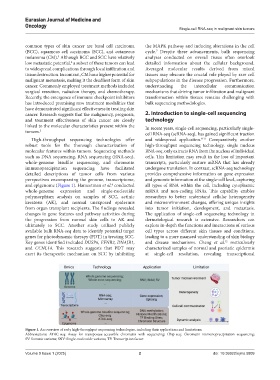
              High-throughput sequencing technologies offer    and widespread application. 8-11  Comparatively, another
            robust  tools for  the  thorough  characterization  of   high-throughput sequencing technology, single nucleus
            molecular features within tumors. Sequencing methods   RNA-seq, only extracts RNA from the nucleus of individual
            such as DNA sequencing, RNA sequencing (RNA-seq),   cells. This limitation may result in the loss of important
            whole-genome bisulfite sequencing, and chromatin   transcripts, particularly mature mRNA that has already
            immunoprecipitation  sequencing  have  facilitated  undergone translation. In contrast, scRNA-seq technology
            detailed descriptions of tumor cells from various   provides comprehensive information on gene expression
            perspectives encompassing the genome, transcriptome,   and genomic information at the single-cell level, capturing
            and epigenome (Figure 1). Hameetman et al.  conducted   all types of RNA within the cell, including cytoplasmic
                                                 6
            whole-genome   expression  and  single-nucleotide  mRNA and non-coding RNAs. This capability enables
            polymorphism analysis on samples of SCC, actinic   researchers to better understand cellular heterogeneity
            keratosis (AK), and normal unexposed epidermis     and microenvironment changes, offering unique insights
            from organ transplant recipients. The findings revealed   into tumor initiation, development, and metastasis.
            changes in gene features and pathway activities during   The application of single-cell sequencing technology in
            the  progression  from  normal  skin  cells to  AK  and   dermatological research is extensive. Researchers can
            ultimately to SCC.  Another study utilized publicly   explore in-depth the functions and interactions of various
            available bulk RNA-seq data to identify potential target   cell types across different skin tissues and conditions,
            genes for photodynamic therapy (PDT) in treating SCC.   leading to a more nuanced understanding of skin biology
            Key genes identified included DUSP6, EFNB2, DNAJB1,   and disease mechanisms. Cheng  et  al.  meticulously
                                                                                                 12
            and  CCNL14. This research suggests that PDT may   characterized samples of normal and psoriatic epidermis
            exert its therapeutic mechanism on SCC by inhibiting   at single-cell resolution, revealing transcriptional


            Figure 1. An overview of early high-throughput sequencing technologies, including their applications and limitations.
            Abbreviations: ATAC-seq: Assay for transposase-accessible chromatin with sequencing; Chip-seq: Chromatin immunoprecipitation sequencing;
            SV: Somatic variants; SNV: Single-nucleotide variants; TF: Transcription factor.


            Volume 9 Issue 1 (2025)                         2                               doi: 10.36922/ejmo.5809

