


Page 182 - EJMO-9-1
P. 182
Eurasian Journal of Medicine and
            Oncology
                                                                                Research on hypoxia and ECM in cancer


            Krishnamachary B. and Mironchik Y. have maintained a   publication volume. The color of the nodes represents the
            strong collaborative relationship, co-authoring four papers   average publication time of articles in each journal, and the
            in 2015, 2017, 2018, and 2024, gradually deepening their   connections between nodes indicate citation relationships
            research in this field.                            among the journals.
              Figure 4C presents a three-field plot analysis of author-  Table  4  lists  the  top  10  most  influential  journals  in
            country-institution relationships. The left side represents   this field, comprising a total of 71 papers, which accounts
            authors, the middle indicates countries, and the right side   for 20.23% of all publications. The top three prolific
            indicates institutions. China has the strongest associations   journals are Cancers (12 papers), International Journal
            with both authors (8/10) and institutions (9/10), followed   of Molecular Sciences (11 papers), and Frontiers in
            by the USA (authors = 7/10; institutions = 7/10). Bhujwalla   Oncology  (nine  papers).  Among  the  top  10  journals,  in
            Z.M., the most prolific author, is linked to the USA, Spain,   terms of publication volume, the top three cited journals
            and Germany.                                       are the International Journal of Molecular Sciences (945
                                                               citations), PLOS One (633 citations), and Clinical and
            3.5. Journal and research category analysis        Experimental Metastasis (540 citations). According to the
            A total of 351 papers were published across 201 different   h-index, Cancers has the highest h-index of 8, followed by
            journals. In  Figure  5A, a visualization analysis was   Biomaterials (h-index  =  7) and International Journal of
            conducted based on 52 journals with over two publications.   Molecular Sciences (h-index = 6).
            The size of the nodes corresponds to the publication   Figure 5B presents a double map overlay of scientific
            volume of each journal, with larger nodes indicating higher   journals. The left side displays the distribution of citing
                                                               literature in  journals,  representing the  main  disciplines
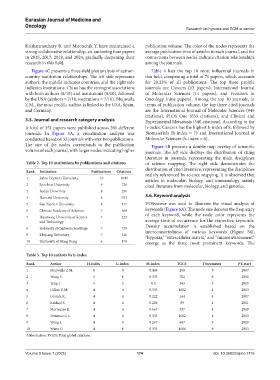
            Table 2. Top 10 institutions by publications and citations  of science mapping. The right side demonstrates the
                                                               distribution of cited literature, representing the disciplines
            Rank  Institution           Publications  Citations  mainly referenced by science mapping. It is observed that
            1     Johns Hopkins University  16      2040       articles in molecular, biology, and immunology mainly
            2     Soochow University        9        726       cited literature from molecular, biology, and genetics.
            3     Fudan University          8        250
            4     Harvard University        8        933       3.6. Keyword analysis
            5     Sun Yat-Sen University    8        117       VOSviewer was used to illustrate the visual analysis of
            6     Chinese Academy of Sciences  7     568       keywords (Figure 6A). The node size denotes the frequency
            7     Huazhong University of Science   7  223      of each keyword, while the node color represents the
                  and Technology                               average time of occurrence for the respective keywords.
            8     University of California San Diego  7  739   Density accumulation  is established based on  the
                                                               interconnectedness  of  various  keywords  (Figure  S4);
            9     Zhejiang University       7        310       “hypoxia,” “extracellular matrix,” and “microenvironment”
            10    University of Hong Kong   6        178       emerge as the three most prominent keywords. The

            Table 3. Top 10 authors by h‑index
            Rank      Author          H‑index     G‑index      M‑index      TGCS       Documents      PY‑start
            1         Bhujwalla Z.M.     8           9           0.444       259           9            2007
            2         Wang Y.            5           6           0.333       702           6            2010
            3         Yang J.            5           5           0.5         363           5            2015
            4         Gilkes D.M.        4           4           0.333       1682          4            2013
            5         Glunde K.          4           4           0.222       164           4            2007
            6         Kakkad S.          4           4           0.286        89           4            2011
            7         Mortezaee K.       4           4           0.667       597           4            2019
            8         Semenza G.L.       4           4           0.333       1682          4            2013
            9         Wang J.            4           5           0.267       667           5            2010
            10        Wirtz D.           4           6           0.333       1686          6            2013
            Abbreviation: TGCS: Total global citations.


            Volume 9 Issue 1 (2025)                        174                              doi: 10.36922/ejmo.7116

