


Page 162 - EJMO-9-2
P. 162
Eurasian Journal of
            Medicine and Oncology                                                 Genetic insights into CAD drug targets


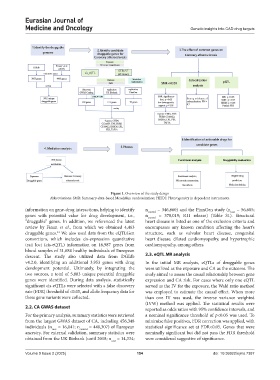
                                                Figure 1. Overview of the study design
                      Abbreviations: SMR: Summary-data-based Mendelian randomization; HEIDI: Heterogeneity in dependent instruments.

            information on gene-drug interactions, helping to identify   n control  = 346,860) and the FinnGen study (n  = 56,685;
                                                                                                   case
            genes with potential value for drug development, i.e.,   n control  = 378,019; R11 release) (Table S1). Structural
            “druggable” genes. In addition, we referenced the latest   heart disease is listed as one of the exclusion criteria and
            review by Finan  et al., from which we obtained 4,463   encompasses any known condition affecting the heart’s
                         13
            druggable genes.  We also used data from the eQTLGen   structure, such as valvular heart disease, congenital
            consortium, which includes cis-expression quantitative   heart disease, dilated cardiomyopathy, and hypertrophic
            trait loci (cis-eQTL) information on 16,987 genes from   cardiomyopathy, among others.
            blood samples of 31,684 healthy individuals of European
            descent. The study also utilized data from DGIdb   2.3. eQTL MR analysis
            v4.2.0,  identifying  an  additional  3,953  genes  with  drug   In the initial MR analysis, eQTLs of druggable genes
            development potential. Ultimately, by integrating the   were utilized as the exposure and CA as the outcome. The
            two sources, a total of 5,883 unique potential druggable   study aimed to assess the causal relationship between gene
            genes were identified. During data analysis, statistically   expression and CA risk. For cases where only one eQTL
            significant cis-eQTLs were selected with a false discovery   served as the IV for the exposure, the Wald ratio method
            rate (FDR) threshold of <0.05, and allele frequency data for   was employed to estimate the causal effect. When more
            these gene variants were collected.                than one IV was used, the inverse variance weighted
                                                               (IVW)  method  was  applied.  The  statistical  results  were
            2.2. CA GWAS dataset                               reported as odds ratios with 95% confidence intervals, and
            For the primary analysis, summary statistics were retrieved   a nominal significance threshold of p<0.05 was used. To
            from the largest GWAS dataset of CA, including 456,348   minimize false positives, FDR correction was applied, with
            individuals (n  = 16,041; n control  = 440,307) of European   statistical significance set at FDR<0.05. Genes that were
                       case
            ancestry. For external validation, summary statistics were   nominally significant but did not pass the FDR threshold
            obtained from the UK Biobank (until 2018; n  = 14,334;   were considered suggestive of significance.
                                                case

            Volume 9 Issue 2 (2025)                        154                              doi: 10.36922/ejmo.7387

