


Page 170 - EJMO-9-2
P. 170
Eurasian Journal of
            Medicine and Oncology                                                 Genetic insights into CAD drug targets


            A                                                  D


            B                                                  E


            C                                                  F


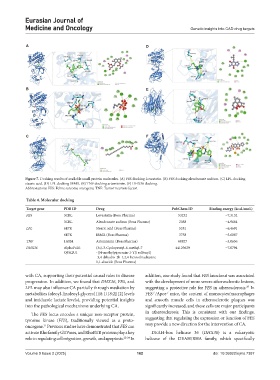
            Figure 7. Docking results of available small protein molecules. (A) FES docking Lovastatin. (B) FES docking alendronate sodium. (C) LPL docking
            stearic acid. (D) LPL docking IBMX. (E) TNF docking artemisinin. (F) DHX36 docking.
            Abbreviations: FES: Feline sarcoma oncogene; TNF: Tumor necrosis factor.

            Table 4. Molecular docking

            Target gene     PDB ID        Drug                            PubChem ID      Binding energy (kcaL/moL)
            FES             3CBL          Lovastatin (Boss Pharma)           53232               −7.3132
                            3CBL          Alendronate sodium (Boss Pharma)   2088                −4.9684
            LPL             6E7K          Stearic acid (Boss Pharma)         5281                −6.4691
                            6E7K          IBMX (Boss Pharma)                 3758                −5.6087
            TNF             1A8M          Artemisinin (Boss Pharma)          68827               −5.0636
            DHX36           AlphaFold:    (3s)-3-Cyclopentyl-6-methyl-7     44129629             −7.0794
                            Q9H2U1        -[(4-methylpiperazin-1-Yl) sulfonyl]
                                          -3,4-dihydro-2h-1,2,4-benzothiadiazine
                                          1,1-dioxide (Boss Pharma)

            with CA, supporting their potential causal roles in disease   addition, one study found that FES knockout was associated
            progression. In addition, we found that DHX36, FES, and   with the development of more severe atherosclerotic lesions,
                                                                                                          25
            LPL may also influence CA partially through mediation by   suggesting a protective role for FES in atherosclerosis.  In
            metabolites (oleoyl-linoleoyl-glycerol [18:1/18:2] [2] levels   FES /Apoe mice, the content of monocytes/macrophages
                                                                  -/-
                                                                        -/-
            and imidazole lactate levels), providing potential insights   and smooth muscle cells in atherosclerotic plaques was
            into the pathological mechanisms underlying CA.    significantly increased, and these cells are major participants
              The FES locus encodes a unique non-receptor protein,   in  atherosclerosis.  This  is  consistent  with  our  findings,
            tyrosine kinase (FES), traditionally viewed as a proto-  suggesting that regulating the expression or function of FES
            oncogene.  Previous studies have demonstrated that FES can   may provide a new direction for the intervention of CA.
                    21
            activate Rho family GTPases, and RhoBTB proteins play a key   DEAH-box helicase 36 (DHX36) is a eukaryotic
            role in regulating cell migration, growth, and apoptosis. 22-24  In   helicase of the DEAH/RHA family, which specifically


            Volume 9 Issue 2 (2025)                        162                              doi: 10.36922/ejmo.7387

