


Page 169 - EJMO-9-2
P. 169
Eurasian Journal of
            Medicine and Oncology                                                 Genetic insights into CAD drug targets


            proteins. In this PPI network, TNF, LPL, FES, and DHX36   3.10. Molecular docking
            have multiple interaction pathways with other proteins,   To further evaluate the binding interactions between
            indicating their central roles in the network. For the PPI   the candidate target genes and the predicted drugs, we
            network  constructed using GeneMANIA,  in addition to   performed a molecular docking analysis (Figure  7). The
            the four core genes, the network also included 20 potential   results indicated that all small molecule compounds
            interacting genes (Figure 6B). Functional analysis of this   were able to enter the binding domains of the target
            network demonstrated that these genes play important   proteins, with binding energies ranging from −4.9684 to
            roles in metabolism and immune regulation, consistent   −7.3132 kcaL/moL (Table 4). Notably, the lovastatin–FES
            with previous enrichment analysis results, further   complex (−7.3132 kcaL/moL) and the (3s)-3-cyclopentyl-
            confirming their potential mechanisms in diseases such as   6-methyl-7-[(4-methylpiperazin-1-Yl)sulfonyl]-3,4-
            CA.                                                dihydro-2h-1,2,4-benzothiadiazine 1,1-dioxide–DHX36
                                                               complex (−7.0794 kcal/mol) demonstrated, particularly
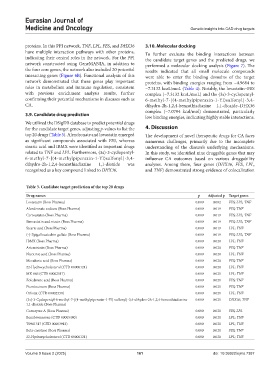
            3.9. Candidate drug prediction                     low binding energies, indicating highly stable interactions.
            We utilized the DSigDB database to predict potential drugs
            for the candidate target genes, adjusting p-values to list the   4. Discussion
            top 20 drugs (Table 3). Alendronate and lovastatin emerged   The development of novel therapeutic drugs for CA faces
            as significant compounds associated with  FES, whereas   numerous challenges, primarily due to the incomplete
            stearic acid and IBMX were identified as important drugs   understanding  of  the  disease’s  underlying  mechanisms.
            related to TNF and LPL. Furthermore, (3s)-3-cyclopentyl-  In this study, we identified nine druggable genes that may
            6-methyl-7-[(4-methylpiperazin-1-Yl)sulfonyl]-3,4-  influence  CA  outcomes  based  on various  druggability
            dihydro-2h-1,2,4-benzothiadiazine  1,1-dioxide  was  analyses. Among them, four genes (DHX36,  FES,  LPL,
            recognized as a key compound linked to DHX36.      and TNF) demonstrated strong evidence of colocalization


            Table 3. Candidate target prediction of the top 20 drugs
            Drug names                                                               p   Adjusted p  Target genes
            Lovastatin (Boss Pharma)                                                0.000   0.002  FES; LPL; TNF
            Alendronate sodium (Boss Pharma)                                        0.000   0.019  FES; TNF
            Cerivastatin (Boss Pharma)                                              0.000   0.019  FES; LPL; TNF
            Simvastatin and niacin (Boss Pharma)                                    0.000   0.019  FES; LPL; TNF
            Stearic acid (Boss Pharma)                                              0.000   0.019  LPL; TNF
            (-)-Epigallocatechin gallate (Boss Pharma)                              0.000   0.019  FES; LPL; TNF
            IBMX (Boss Pharma)                                                      0.000   0.020  LPL; TNF
            Artemisinin (Boss Pharma)                                               0.000   0.020  FES; TNF
            Nicotinic acid (Boss Pharma)                                            0.000   0.020  LPL; TNF
            Mevalonic acid (Boss Pharma)                                            0.000   0.020  FES; TNF
            22-Hydroxycholesterol (CTD 00000121)                                    0.000   0.020  LPL; TNF
            MK 886 (CTD 00002517)                                                   0.000   0.021  LPL; TNF
            Zoledronic acid (Boss Pharma)                                           0.000   0.021  FES; TNF
            Picrotoxinum (Boss Pharma)                                              0.000   0.021  FES; TNF
            Orlistat (CTD 00002339)                                                 0.000   0.021  LPL; TNF
            (3s)-3-Cyclopentyl-6-methyl-7-[(4-methylpiperazin-1-Yl) sulfonyl]-3,4-dihydro-2h-1,2,4-benzothiadiazine   0.000  0.021  DHX36; TNF
            1,1-dioxide (Boss Pharma)
            Coenzyme A (Boss Pharma)                                                0.000   0.021  FES; LPL
            Benzbromarone (CTD 00005480)                                            0.000   0.021  LPL; TNF
            T0901317 (CTD 00003912)                                                 0.000   0.021  LPL; TNF
            Beta-carotene (Boss Pharma)                                             0.000   0.021  FES; TNF
            22-Hydroxycholesterol (CTD 00000121)                                    0.000   0.020  LPL; TNF


            Volume 9 Issue 2 (2025)                        161                              doi: 10.36922/ejmo.7387

