


Page 168 - EJMO-9-2
P. 168
Eurasian Journal of
            Medicine and Oncology                                                 Genetic insights into CAD drug targets


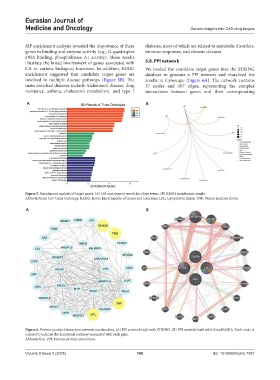
            MF enrichment analysis revealed the importance of these   diabetes, most of which are related to metabolic disorders,
            genes in binding and enzyme activity (e.g., G-quadruplex   immune responses, and chronic diseases.
            DNA binding, phospholipase A1 activity). These results
            illustrate the broad involvement of genes associated with   3.8. PPI network
            CA  in  various  biological  functions.  In  addition,  KEGG   We loaded the candidate target genes into the STRING
            enrichment suggested that candidate target genes are   database to generate a PPI network and visualized the
            involved in multiple disease pathways (Figure  5B). The   results in Cytoscape (Figure  6A). The network contains
            main enriched diseases include Alzheimer’s disease, drug   37  nodes  and  107  edges,  representing  the  complex
            resistance, asthma, cholesterol metabolism, and type  I   interactions between genes and their corresponding


             A                                                 B


            Figure 5. Enrichment analysis of target genes. (A) GO enrichment results for three terms. (B) KEGG enrichment results.
            Abbreviations: GO: Gene Ontology; KEGG: Kyoto Encyclopedia of Genes and Genomes; LPL: Lipoprotein lipase; TNF: Tumor necrosis factor.

            A                                                  B


            Figure 6. Protein-protein interaction network construction. (A) PPI network built with STRING. (B) PPI network built with GeneMANIA. Each circle is
            colored to indicate the functional pathway associated with each gene.
            Abbreviation: PPI: Protein-protein interaction.


            Volume 9 Issue 2 (2025)                        160                              doi: 10.36922/ejmo.7387

