


Page 210 - EJMO-9-2
P. 210
Eurasian Journal of
            Medicine and Oncology                                             Tetramethyl thyroxine boosts bladder cancer


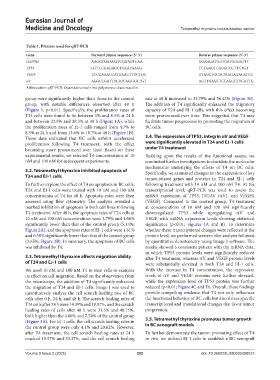
            Table 1. Primers used for qRT‑PCR
            Gene                        Forward primer sequence (5’‑3’)               Reverse primer sequence (5’‑3’)
            GAPDH                       AAGGTGAAGGTCGGAGTCAA                          GGAAGATGGTGATGGGATTT
            TP53                        GTTCCGAGAGCTGAATGAGG                          TCTGAGTCAGGCCCTTCTGT
            VEGF                        TCCGAAACCATGAACTTTCTGC                        GTAGCTGCGCTGATAGACATCC
            αV                          AGGCTGATTTCATCGGGGTTGT                        AGTTGAGTTCCAGCCTTCATTG
            Abbreviation: qRT-PCR: Quantitative real-time polymerase chain reaction.
            group were significantly higher than those in the control   rate at 48 h increased to 33.79% and 56.42% (Figure 3B).
            group, with notable differences observed after 48  h   The addition of T4 significantly enhanced the migratory
            (Figure  1,  p<0.01). Specifically, the proliferation rates of   capacity of T24 and EJ-1 cells, with this effect becoming
            T24 cells were found to be between 5% and 8.5% at 24 h   more pronounced over time. This suggested that T4 may
            and between 22.8% and 28.3% at 48 h (Figure 1A), while   facilitate tumor progression by promoting the migration of
            the proliferation rates of EJ-1 cells ranged from 4.7% to   BC cells.
            8.5% at 24 h and from 13.6% to 18.7% at 48 h (Figure 1B).
            These data indicated that BC cells exhibit accelerated   3.4. The expression of TP53, integrin αV and VEGF
            proliferation following T4 treatment, with the effect   were significantly elevated in T24 and EJ-1 cells
            becoming more pronounced over time. Based on these   under T4 treatment
            experimental results, we selected T4 concentrations of 10   Building upon the results of the functional assays, we
            nM and 100 nM for subsequent experiments.          conducted further investigations to elucidate the molecular
                                                               mechanisms underlying  the effects  of T4  on  BC cells.
            3.2. Tetramethyl thyroxine inhibited apoptosis of   Specifically, we examined changes in the expression of key
            T24 and EJ-1 cells                                 tumor-related genes and proteins in T24 and EJ-1  cells
            To further explore the effect of T4 on apoptosis in BC cells,   following treatment with 10 nM and 100 nM T4. At the
            T24 and EJ-1 cells were treated with 10 nM and 100 nM   transcriptional level, qRT-PCR was used to assess the
            concentrations of T4 for 48 h. Apoptotic rates were then   mRNA expression of TP53, ITGAV (αV), and VEGFA
            assessed using flow cytometry. The analysis revealed a   (VEGF).  Compared  to  the  control  group,  T4  treatment
            marked inhibition of apoptosis in both cell lines following   at concentrations of 10 nM and 100 nM significantly
            T4 treatment. After 48 h, the apoptosis rates of T24 cells at   downregulated  TP53  while  upregulating  αV  and
            10 nM and 100 nM concentrations were 2.79% and 1.66%   VEGF, with mRNA expression levels showing statistical
            significantly lower than that of the control group (5.14%;   significance (p<0.01;  Figures  4A and  B). To determine
            Figure 2A), and the apoptosis rates of EJ-1 cells were 1.81%   whether these transcriptional changes were reflected at the
            and 0.58% significantly lower than that of the control group   protein level, we performed western blot analysis followed
            (3.65%; Figure 2B). In summary, the apoptosis of BC cells   by quantitative densitometry using Image J software. The
            was inhibited by T4.                               results showed a consistent pattern with the mRNA data,
                                                               in which TP53 protein levels were significantly reduced
            3.3. Tetramethyl thyroxine affects migration ability   after T4 treatment, whereas αV and VEGF protein levels
            of T24 and EJ-1 cells                              were substantially elevated in both T24 and EJ-1  cells.
            We used 10 nM and 100 nM T4 to treat cells to examine   With the increase in T4 concentration, the expression
            its effect on cell migration. Based on the observation from   levels of  αV and VEGF proteins were further elevated,
            the microscope, the addition of T4 significantly enhanced   while the expression level of TP53 protein was further
            the migration of T24 and EJ-1 cells. Image J was used to   reduced (p<0.01; Figure 4C and D). Overall, these findings
            quantitatively analyze the cell scratch healing rate of BC   provide compelling evidence that T4 not only influences
            cells after 0 h, 24 h, and 48 h. The scratch healing rates of   the functional behavior of BC cells but also drives specific
            T24 cells after 24 h were 14.39% and 19.97%, and the scratch   transcriptional and translational changes that favor tumor
            healing rates of cells after 48 h were 31.5% and 48.75%,   progression.
            both higher than the 4.66% and 7.74% of the control group
            (Figure 3A). For EJ-1 cells, the cell scratch healing rates in   3.5. Tetramethyl thyroxine promotes tumor growth
            the control group were only 4.1% and 20.62%. However,   in BC xenograft models
            after T4 treatment, the cell scratch healing rates at 24 h   To further demonstrate the tumor-promoting effect of T4
            reached 15.57% and 33.37%, and the cell scratch healing   in vivo, we utilized EJ-1 cells to establish a BC xenograft


            Volume 9 Issue 2 (2025)                        202                         doi: 10.36922/EJMO025080037

