


Page 211 - EJMO-9-2
P. 211
Eurasian Journal of
            Medicine and Oncology                                             Tetramethyl thyroxine boosts bladder cancer


            A                                                  tumor model. Tumor-bearing mice were divided into a
                                                               control group and a T4 treatment group, with five mice
                                                               in each group. Changes in tumor volume were recorded
                                                               every 3  days. By the 30   day, the tumor volume in the
                                                                                   th
                                                               T4 treatment group reached 545.47 mm³, compared to
                                                               251.5 mm³ in the control group (Figure 5A and B). On
                                                                    th
                                                               the 30   day, the mice were sacrificed, and the tumors
                                                               were excised and weighed. The mass of the tumor in the
                                                               T4 group post-treatment (0.58044  g) was significantly
                                                               higher than that in the untreated group (0.29566 g; p<0.01;
            B
                                                               Figure  5A  and  C). In addition, we collected tail blood
                                                               samples  from  the  mice  to  measure  the  concentrations
                                                               of T4, T3, and TSH in the serum, with T4 serving as the
                                                               precursor to T3. The observed increase in serum T4 and T3
                                                               levels, along with a decrease in TSH (Figure 5D), indicates
                                                               signs of hyperthyroidism.  The experimental results
                                                                                     11
                                                               revealed that by the 28  day, the serum levels of T4 and
                                                                                  th
                                                               T3 had significantly increased, while the concentration of
                                                               TSH had decreased. T4-induced hyperthyroidism in mice
                                                               may influence the course of tumor development.
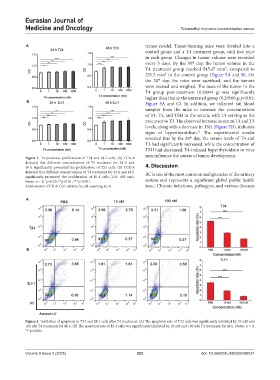
            Figure 1. T4 promotes proliferation of T24 and EJ-1 cells. (A) CCK-8
            detected that different concentrations of T4 treatment for 24  h and
            48  h  significantly  promoted  the  proliferation  of  T24  cells.  (B)  CCK-8   4. Discussion
            detected that different concentrations of T4 treatment for 24 h and 48 h   BC is one of the most common malignancies of the urinary
            significantly promoted the proliferation of EJ-1  cells (OD: 450  nm).
            Notes: n = 3; *p<0.05; **p<0.01; ***p<0.001.       system and represents a significant global public health
            Abbreviation: CCK-8: Cell viability by cell counting kit-8.  issue. Chronic infections, pathogens, and various diseases

            A


            B


            Figure 2. Inhibition of apoptosis in T24 and EJ-1 cells after T4 treatment. (A) The apoptosis rate of T24 cells was significantly inhibited by 10 nM and
            100 nM T4 treatment for 48 h. (B) The apoptosis rate of EJ-1 cells was significantly inhibited by 10 nM and 100 nM T4 treatment for 48 h. Notes: n = 3;
            ***p<0.001.


            Volume 9 Issue 2 (2025)                        203                         doi: 10.36922/EJMO025080037

