


Page 216 - EJMO-9-2
P. 216
Eurasian Journal of
            Medicine and Oncology                                             Tetramethyl thyroxine boosts bladder cancer


                                 Figure 6. The molecular mechanism of T4 promoting the occurrence of bladder cancer

            effects  of  T4  on  different  types  of  BC,  with  particular   research in future studies, further elucidate the biological
            attention to the responses of patient-derived xenografts   mechanisms by which T4 hormone regulates BC through
            to T4. The BBN-induced orthotopic BC model, which   the  αV and VEGF pathways, and provide important
            simulates the prolonged process of tumorigenesis, serves   reference for future clinical translation.
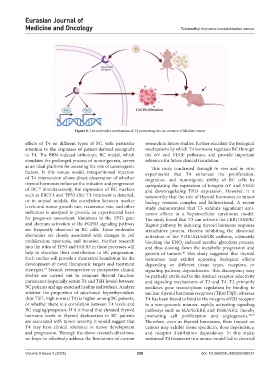
            as an ideal platform for assessing the role of carcinogenic   This study confirmed through  in vivo and  in vitro
            factors. In this mouse model, intraperitoneal injection   experiments that T4 enhances the proliferation,
            of T4 intervention allows direct observation of whether   migration, and tumorigenic ability of BC cells by
            thyroid hormones influence the initiation and progression   upregulating the expression of integrin  αV and VEGF
                 43
            of BC.  Simultaneously, the expression of BC markers   and downregulating TP53  expression. However, it  is
            such as ERCC1 and TP53 after T4 treatment is detected,   noteworthy that the role of thyroid hormones in tumor
            or in animal models, the correlation between marker   biology remains complex and bidirectional. A  recent
            levels and tumor growth rate, recurrence rate, and other   study demonstrated that T3 exhibits significant anti-
            indicators is analyzed to provide an experimental basis   tumor effects in a hepatocellular carcinoma model.
            for prognosis assessment. Mutations in the  TP53 gene   The study found that T3 can activate the LKB1/AMPK/
            and aberrant activation of the FGFR3 signaling pathway   Raptor pathway by inducing thyroid hormone response
            are  frequently  observed  in  BC  cells.  These  molecular   stimulatory protein, thereby inhibiting the abnormal
            alterations are closely associated with changes in cell   activation of the PI3K/Akt/mTOR pathway, ultimately
            proliferation, apoptosis, and invasion. Further research   blocking the ENO -induced aerobic glycolysis process,
                                                                              2
            into the roles of TP53 and FGFR3 in these processes will   and thus slowing down the metabolic progression and
            help to elucidate their contribution to BC progression.   growth of tumors.  This study suggested that thyroid
                                                                               45
            Such studies will provide a theoretical foundation for the   hormones may exhibit opposing biological effects
            development of novel therapeutic targets and treatment   depending on different tissue types, receptors, or
                    44
            strategies.  Second, retrospective or prospective clinical   signaling pathway dependencies. This discrepancy may
            studies are carried out to compare thyroid function   be partially attributed to the distinct receptor selectivity
            parameters (especially serum T4 and TSH levels) between   and signaling mechanisms of T3 and T4. T3 primarily
            BC patients and age-matched healthy individuals. Analyze   mediates gene transcription regulation by binding to
            whether the proportion of subclinical hyperthyroidism   nuclear thyroid hormone receptors (TRα/TRβ), whereas
            (low TSH, high normal T4) is higher among BC patients,   T4 has been found to bind to the integrin αVβ3 receptor
            or whether there is a correlation between T4 levels and   in a non-genomic manner, rapidly activating signaling
            BC staging/prognosis. If it is found that elevated thyroid   pathways such as MAPK/ERK and PI3K/AKT, thereby
            hormone  levels  or  thyroid  dysfunction  in  BC  patients   promoting cell proliferation and angiogenesis. 46,47
            are associated with tumor severity, it would suggest that   Therefore, even as thyroid hormones, their impact on
            T4 may have clinical relevance in tumor development   tumors may exhibit tissue specificity, dose dependency,
            and progression. Through the above research directions,   and receptor distribution dependency. In this study,
            we hope to effectively address the limitations of current   sustained T4 treatment in a mouse model led to elevated


            Volume 9 Issue 2 (2025)                        208                         doi: 10.36922/EJMO025080037

