


Page 213 - EJMO-9-2
P. 213
Eurasian Journal of
            Medicine and Oncology                                             Tetramethyl thyroxine boosts bladder cancer


                         A                                   B


                         C


                         D


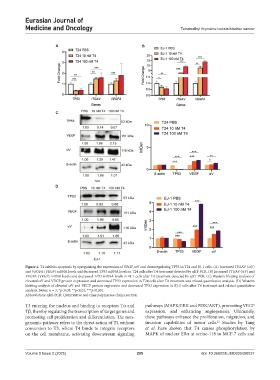
            Figure 4. T4 inhibits apoptosis by upregulating the expression of VEGF, αV and downregulating TP53 in T24 and EJ-1 cells. (A) Increased ITGAV (αV)
            and VEGFA (VEGF) mRNA levels and decreased TP53 mRNA levels in T24 cells after T4 treatment detected by qRT-PCR. (B) Increased ITGAV (αV) and
            VEGFA (VEGF) mRNA levels and decreased TP53 mRNA levels in EJ-1 cells after T4 treatment detected by qRT-PCR. (C) Western blotting analysis of
            elevated αV and VEGF protein expression and decreased TP53 expression in T24 cells after T4 treatment and related quantitative analysis. (D) Western
            blotting analysis of elevated αV and VEGF protein expression and decreased TP53 expression in EJ-1 cells after T4 treatment and related quantitative
            analysis. Notes: n = 3; *p<0.05; **p<0.01; ***p<0.001.
            Abbreviation: qRT-PCR: Quantitative real-time polymerase chain reaction.
            T3 entering the nucleus and binding to receptors Tα and   pathways (MAPK/ERK and PI3K/AKT), promoting VEGF
            Tβ, thereby regulating the transcription of target genes and   expression, and enhancing angiogenesis. Ultimately,
            promoting cell proliferation and differentiation. The non-  these pathways enhance the proliferation, migration, and
            genomic pathway refers to the direct action of T4 without   invasion  capabilities  of  tumor  cells.   Studies  by  Tang
                                                                                             23
            conversion to T3, where T4 binds to integrin receptors   et al. have shown that T4 causes phosphorylation by
            on the cell membrane, activating downstream signaling   MAPK of nuclear ERα at serine-118 in MCF-7 cells and


            Volume 9 Issue 2 (2025)                        205                         doi: 10.36922/EJMO025080037

