


Page 102 - EJMO-9-3
P. 102
Eurasian Journal of
            Medicine and Oncology                                           Novel senescence-based melanoma risk model


            A                                                    B


            C                                                    D


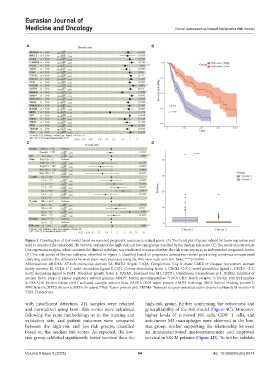
            Figure 3. Construction of risk model based on screened prognostic senescence-related genes. (A) The forest plot of genes refined by Lasso regression and
            used to construct the risk model. (B) Survival analysis of the high-risk and low-risk groups classified by the median risk score. (C) The result of multivariate
            Cox regression analysis, which accounts for clinical variables, was conducted to assess whether the risk score serves as an independent prognostic factor.
            (D) The risk scores of the two subtypes identified in Figure 1, classified based on prognostic senescence-related genes using consensus unsupervised
            clustering analysis. The differences between them were evaluated using the Wilcoxon rank-sum test. Note: ****p<0.0001.
            Abbreviations: ARID5A: AT-rich interaction domain 5A; BSCL2: Seipin; C1QA: Complement C1q A chain; CARD10: Caspase recruitment domain
            family member 10; CCL8: C-C motif chemokine ligand 8; CSF1: Colony stimulating factor 1; CXCL1: C-X-C motif chemokine ligand 1; CXCL5: -X-C
            motif chemokine ligand 5; FGF1: Fibroblast growth factor 1; FOXM1: Forkhead box M1; GSTP1: Glutathione S-transferase pi 1; IKBKG: Inhibitor of
            nuclear factor kappa B kinase regulatory subunit gamma; MMP7: Matrix metallopeptidase 7; NOTCH3: Notch receptor 3; NOX4: NADPH oxidase
            4; PRKACB: Protein kinase cAMP-activated catalytic subunit beta; RAD52: DNA repair protein RAD52 homolog; RBP2: Retinol binding protein 2;
            SFN: Stratifin; SIRT3: Sirtuin 3; SIRT6: Sirtuin 6; TP63: Tumor protein p63; TRPM8: Transient receptor potential cation channel subfamily M member 8;
            TXN: Thioredoxin.

            with insufficient detection, 214  samples were retained   high-risk group, further  confirming  the  robustness and
            and  normalized  using  lumi.  Risk  scores  were  calculated   generalizability of the risk model (Figure 4C). Moreover,
            following the same methodology as in the training and   higher levels of activated NK cells, CD8  T cells, and
                                                                                                  +
            validation sets, and patient outcomes were compared   anti-tumor M1 macrophages were observed in the low-
            between the high-risk and low-risk groups, classified   risk group, further supporting the relationship between
            based on the median risk scores. As expected, the low-  an immunoactivated microenvironment and improved
            risk group exhibited significantly better survival than the   survival in SKCM patients (Figure 4D). To further validate


            Volume 9 Issue 3 (2025)                         94                              doi: 10.36922/ejmo.8574

