


Page 188 - EJMO-9-3
P. 188
Eurasian Journal of
            Medicine and Oncology                                                  Research on DSY in treating gastritis


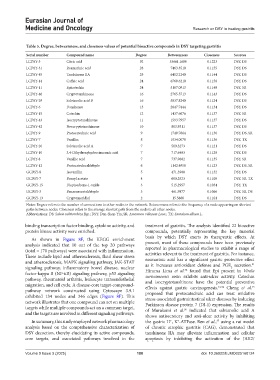
            Table 5. Degree, betweenness, and closeness values of potential bioactive compounds in DSY targeting gastritis
            Serial number    Compound name                 Degree       Betweenness     Closeness    Sources
            LCDSY-3          Citric acid                    92           33661.1680      0.1223      DSY, DS
            LCDSY-31         Rosmarinic acid                28            7463.3510      0.1155      DSY, DS
            LCDSY-45         Tanshinone IIA                 25            6402.2240      0.1144      DSY, DS
            LCDSY-14         Caffeic acid                   24            6760.6210      0.1158      DSY, DS
            LCDSY-11         Epicatechin                    24            5167.0913      0.1149      DSY, SR
            LCDSY-46         Cryptotanshinone               16            2765.5713      0.1143      DSY, DS
            LCDSY-29         Salvianolic acid B             16            5837.8240      0.1124      DSY, DS
            LCDSY-6          Danshensu                      13            2847.7444      0.1134      DSY, DS
            LCDSY-15         Catechin                       12            1437.6676      0.1137      DSY, SR
            LCDSY-43         Isocryptotanshinone            11            1593.7957      0.1137      DSY, DS
            LCDSY-42         Neocryptotanshinone            10            803.9311       0.1137      DSY, DS
            LCDSY-9          Protocatechuic acid             9            1740.7864      0.1136      DSY, DS, SR
            LCDSY-7          Vanillin                        8            1034.0078      0.1136      DSY, TX
            LCDSY-20         Salvianolic acid A              7            509.3273       0.1121      DSY, DS
            LCDSY-10         3,4-Dihydroxyhydrocinnamic acid  7           717.6403       0.1128      DSY, DS
            LCDSY-8          Vanillic acid                   7            737.9602       0.1135      DSY, SR
            LCDSY-12         Protocatechualdehyde            6            1142.4958      0.1123      DSY, DS, SR
            GCDSY-8          Isovanillin                     5            471.3908       0.1132      DSY, DS
            GCDSY-7          Bornyl acetate                  4            600.2523       0.1105      DSY, SR, TX
            GCDSY-15         Diepicedrene-1-oxide            3            515.2957       0.1034      DSY, TX
            GCDSY-3          Benzeneacetaldehyde             3            461.9877       0.1066      DSY, SR, DS
            GCDSY-13         Cryptomeridiol                  2            15.5880        0.1101      DSY, DS
            Notes: Degree refers to the number of connections to other nodes in the network. Betweenness refers to the frequency of a node appearing on shortest
            paths between nodes. Closeness refers to the average shortest path from the node to all other nodes.
            Abbreviations: DS: Salvia miltiorrhiza Bge.; DSY: Dan-Shen-Yin; SR: Amomum villosum Lour.; TX: Santalum album L.

            binding transcription factor binding, cytokine activity, and   treatment of gastritis. The analysis identified 22 bioactive
            protein kinase activity were enriched.             compounds, potentially representing the key material
              As shown in  Figure  8F, the KEGG enrichment     basis by which DSY exerts its therapeutic effects. At
            analysis indicated that 10 out of the top 20 pathways   present, most of these compounds have been previously
            (total = 170 pathways) were associated with inflammation.   reported in pharmacological studies to exhibit a range of
            These include lipid and atherosclerosis, fluid shear stress   activities relevant to the treatment of gastritis. For instance,
            and atherosclerosis, MAPK signaling pathway, JAK-STAT   rosmarinic acid has a significant gastric protective effect
                                                                                                            31
            signaling pathway, inflammatory bowel disease, nuclear   as it increases antioxidant defense and PGE   secretion.
                                                                                                   2
                                                                                32
            factor-kappa B (NF-κB) signaling pathway, p53 signaling   Hiruma Lima  et  al.  found that Epi present in  Virola
                                                               surinamensis resin exhibits anti-ulcer activity. Catechin
            pathway, rheumatoid arthritis, leukocyte transendothelial   and isocryptotanshinone have the potential preventive
            migration, and cell cycle. A disease-core target-compound-  effects against gastric carcinogenesis. 33,34  Cheng  et al.
                                                                                                            35
            pathway  network  constructed  using  Cytoscape  3.9.1   proposed that protocatechuic acid can treat oxidative
            exhibited 134 nodes and 346 edges (Figure  8F). This   stress-associated gastrointestinal ulcer diseases by inducing
            network illustrates that one compound can act on multiple   Parkinson disease protein 7 (DJ-1) expression. The results
            targets while multiple compounds act on a common target,   of Murakami  et al.  indicated that salvianolic acid A
                                                                               36
            and the targets are involved in different signaling pathways.
                                                               shows antisecretory and anti-ulcer activity by inhibiting
              In summary, this study employed network pharmacology   the gastric H , K -ATPase. Ren et al.,  using a rat model
                                                                                             37
                                                                         +
                                                                             +
            analysis based  on  the  comprehensive  characterization of   of chronic atrophic gastritis (CAG), demonstrated that
            DSY decoction, thereby elucidating its active compounds,   tanshinone IIA may alleviate inflammation and cellular
            core targets, and associated pathways involved in the   apoptosis by inhibiting the activation of the JAK2/
            Volume 9 Issue 3 (2025)                        180                         doi: 10.36922/EJMO025160124

