


Page 218 - EJMO-9-3
P. 218
Eurasian Journal of
            Medicine and Oncology                                              FN3K–Nrf2 axis inhibition in breast cancer


            – MCF-7, T-47D, and BT-474 – as well as in the non-  exhibits tumor-selective activity, potentially minimizing the
            malignant Vero cell line. This analysis aimed to explore   risk of off-target effects in non-cancerous cells.
            the differential modulation of FN3K and Nrf2 following
            treatment with oxaliplatin, lansoprazole, and capivasertib,   3.2.3.2. Nrf2 inhibition follows FN3K suppression selectively in
            thereby evaluating both the selectivity and efficacy of these   cancer cells
            agents in targeting cancerous versus non-cancerous cells.  In cancer cells, Nrf2 expression was significantly
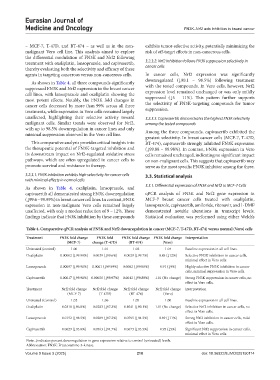
              As shown in Table 4, all three compounds significantly   downregulated (↓90.1 – 98.5%) following treatment
            suppressed FN3K and Nrf2 expression in the breast cancer   with the tested compounds. In Vero cells, however, Nrf2
            cell lines, with lansoprazole and oxaliplatin showing the   expression level remained unchanged or was only mildly
            most potent effects. Notably, the FN3K fold changes in   suppressed  (↓5  –  11%).  This  pattern  further  supports
            cancer cells decreased by more than 99% across all three   the  selectivity of  FN3K-targeting  compounds  for  tumor
            treatments, while expression in Vero cells remained largely   suppression.
            unaffected, highlighting their selective activity toward   3.2.3.3. Capivasertib demonstrates the highest FN3K selectivity
            malignant cells. Similar trends were observed for Nrf2,   among the tested compounds
            with up to 98.5% downregulation in cancer lines and only   Among the three compounds, capivasertib exhibited the
            minimal suppression observed in the Vero cell line.
                                                               greatest selectivity. In breast cancer cells (MCF-7, T-47D,
              This comparative analysis provides critical insights into   BT-474), capivasertib strongly inhibited FN3K expression
            the therapeutic potential of FN3K-targeted inhibition and   (↓99.88 – 99.98%). In contrast, FN3K expression in Vero
            its downstream impact on Nrf2-regulated oxidative stress   cells remained unchanged, indicating no significant impact
            pathways, which are often upregulated in cancer cells to   on non-malignant cells. This suggests that capivasertib may
            promote survival and resistance to therapy.        serve as the most specific FN3K inhibitor among the three.

            3.2.3.1. FN3K inhibition exhibits high selectivity for cancer cells   3.3. Statistical analysis
            with minimal effects in normal cells
            As shown in  Table 4, oxaliplatin, lansoprazole, and   3.3.1. Differential expression of FN3K and Nrf2 in MCF-7 Cells
            capivasertib all demonstrated strong FN3K downregulation   qPCR analysis of FN3K and Nrf2 gene expression in
            (↓99.6 – 99.99%) in breast cancer cell lines. In contrast, FN3K   MCF-7 breast cancer cells treated with oxaliplatin,
            expression  in  non-malignant  Vero  cells  remained largely   lansoprazole, capivasertib, amiloride, ritonavir, and 1-DMF
            unaffected, with only a modest reduction of 9 – 12%. These   demonstrated notable alterations in transcript levels.
            findings indicate that FN3K inhibition by these compounds   Statistical evaluation was performed using either Welch’s

            Table 4. Comparative qPCR analysis of FN3K and Nrf2 downregulation in cancer (MCF-7, T-47D, BT-474) versus normal (Vero) cells
            Treatment     FN3K fold change   FN3K fold   FN3K fold change  FN3K fold change  Interpretation
                             (MCF-7)    change (T-47D)  (BT-474)      (Vero)
            Untreated (control)  1.00       1.01          1.02         1.04     Baseline expression in all cell lines.
            Oxaliplatin    0.00002 (↓99.99%)  0.0039 (↓99.6%)  0.0029 (↓99.7%)  0.88 (↓12%)  Selective FN3K inhibition in cancer cells,
                                                                                minimal effect in Vero cells.
            Lansoprazole   0.00097 (↓99.90%)  0.0001 (↓99.99%)  0.0002 (↓99.98%)  0.91 (↓9%)  Highly selective FN3K inhibition in cancer
                                                                                cells, minimal suppression in Vero cells.
            Capivasertib   0.00017 (↓99.98%) 0.00026 (↓99.97%)  0.0012 (↓99.88%)  1.01 (No change)  Strong FN3K suppression in cancer cells, no
                                                                                effect in Vero cells.
            Treatment      Nrf2 fold change   Nrf2 fold change   Nrf2 fold change   Nrf2 fold change  Interpretation
                              (MCF-7)      (T-47D)      (BT-474)      (Vero)
            Untreated (Control)  1.02       1.06          1.05         1.00     Baseline expression in all cell lines.
            Oxaliplatin    0.0318 (↓96.8%)  0.0283 (↓97.3%)  0.1041 (↓90.1%)  1.01 (No change)  Selective Nrf2 inhibition in cancer cells, no
                                                                                effect in Vero cells.
            Lansoprazole   0.0152 (↓98.5%)  0.0289 (↓97.2%)  0.0595 (↓94.3%)  0.89 (↓11%)  Strong Nrf2 inhibition in cancer cells, mild
                                                                                effect in Vero cells.
            Capivasertib   0.0629 (↓93.8%)  0.0563 (↓94.7%)  0.0673 (↓93.5%)  0.95 (↓5%)  Significant Nrf2 suppression in cancer cells,
                                                                                minimal effect in Vero cells.
            Note: ↓indicates percent downregulation in gene expression relative to control (untreated) levels.
            Abbreviation: FN3K: Fructosamine-3-kinase.
            Volume 9 Issue 3 (2025)                        210                         doi: 10.36922/EJMO025150114

