


Page 221 - EJMO-9-3
P. 221
Eurasian Journal of
            Medicine and Oncology                                              FN3K–Nrf2 axis inhibition in breast cancer


                                                               these, oxaliplatin exhibited the most potent suppression,
                                                               reducing FN3K levels by approximately 66% relative to
                                                               the untreated control, closely followed by capivasertib.
                                                               These findings suggest that FN3K inhibition may be a
                                                               key mechanism underlying the anti-cancer activity of
                                                               oxaliplatin and capivasertib. Moderate suppression of
                                                               FN3K expression was observed with 1-DMF (0.636) and
                                                               ritonavir (0.834), indicating a less pronounced but still
                                                               notable  inhibitory  effect.  This  suggests  that  while  these
                                                               compounds interfere with FN3K function, their effects
                                                               are weaker compared to oxaliplatin and capivasertib. In
                                                               contrast, amiloride (0.976) had minimal impact on FN3K
                                                               expression, implying that its mechanism of action does
                                                               not involve FN3K inhibition and may instead act through
                                                               alternative metabolic or signaling pathways.
                                                               3.4.1.2. Nrf2 expression analysis
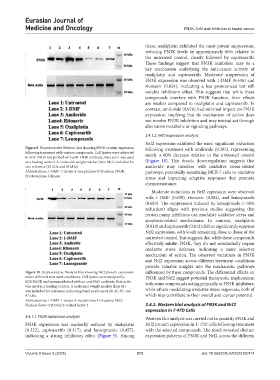
                                                               Nrf2 expression exhibited the most significant reduction
            Figure 9. Representative Western blot showing FN3K protein expression   following treatment with amiloride (0.393), representing
            following treatment with various compounds. Cell lysates were subjected   nearly a 60% decrease relative to the untreated control
            to SDS-PAGE and probed with anti-FN3K antibody. Beta actin was used
            as a loading control. A molecular weight marker (lane M) is included for   (Figure  10). This drastic downregulation suggests that
            size reference (29 kDa and 45 kDa)                 amiloride may interfere with oxidative stress-related
            Abbreviations: 1-DMF: 1-deoxy-1-morpholino-D-fructose; FN3K:   pathways, potentially sensitizing MCF-7 cells to oxidative
            Fructosamine-3-kinase                              stress and impairing adaptive responses that promote
                                                               chemoresistance.
                                                                 Moderate reductions in Nrf2 expression were observed
                                                               with 1-DMF (0.639), ritonavir (0.584), and lansoprazole
                                                               (0.683). The suppression  induced by  lansoprazole  (~30%
                                                               reduction) aligns with previous studies suggesting that
                                                               proton pump inhibitors can modulate oxidative stress and
                                                               apoptosis-related mechanisms. In contrast, oxaliplatin
                                                               (0.818) and capivasertib (0.812) did not significantly suppress
                                                               Nrf2 expression, with levels remaining close to those of the
                                                               untreated control. This suggests that while these compounds
                                                               effectively inhibit FN3K, they do not substantially impair
                                                               oxidative stress defenses, indicating a more selective
                                                               mechanism of action. The observed variations in FN3K
                                                               and Nrf2 expression across different treatment conditions
                                                               provide valuable insights into the mechanistic pathways
            Figure 10. Representative Western blot showing Nrf2 protein expression   influenced by these compounds. The differential effects on
            under different treatment conditions. Cell lysates were analyzed by   FN3K and Nrf2 suggest potential therapeutic implications,
            SDS-PAGE and immunoblotted with an anti-Nrf2 antibody. Beta actin   with some compounds acting primarily as FN3K inhibitors,
            was used as a loading control. A molecular weight marker (lane M)
            was included for reference, indicating band positions at 29, 45, 67, and   while others modulating oxidative stress responses, both of
            97 kDa                                             which may contribute to their overall anti-cancer potential.
            Abbreviations: 1-DMF: 1-deoxy-1-morpholino-D-fructose; Nrf2:
            Nuclear factor erythroid 2-related factor 2        3.4.2. Western blot analysis of FN3K and Nrf2
                                                               expression in T-47D Cells
            3.4.1.1. FN3K expression analysis                  Western blot analysis was carried out to quantify FN3K and
            FN3K  expression  was  markedly  reduced  by oxaliplatin   Nrf2 protein expression in T-47D cells following treatment
            (0.322),  capivasertib  (0.317),  and  lansoprazole  (0.457),   with the selected compounds. The result revealed distinct
            indicating a strong inhibitory effect (Figure  9). Among   expression patterns of FN3K and Nrf2 across the different


            Volume 9 Issue 3 (2025)                        213                         doi: 10.36922/EJMO025150114

