


Page 225 - EJMO-9-3
P. 225
Eurasian Journal of
            Medicine and Oncology                                              FN3K–Nrf2 axis inhibition in breast cancer


            reinforce FN3K as a promising therapeutic target, with   reducing  Nrf2  expression.  Meanwhile,  although  1-DMF,
            minimal impact on oxidative stress regulatory pathways.  amiloride, and ritonavir did not significantly impact FN3K
                                                               levels, their ability to suppress Nrf2 suggests possible
            3.6. Statistical analysis of FN3K and Nrf2 expression   alternative mechanisms of action related to oxidative stress
            in MCF-7 Cells                                     and redox balance in MCF-7 cells.
            Statistical evaluation of FN3K and Nrf2 protein expression
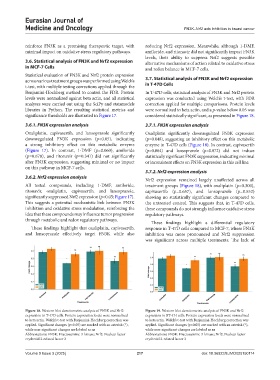
            across various treatment groups was performed using Welch’s   3.7. Statistical analysis of FN3K and Nrf2 expression
            t-test, with multiple testing corrections applied through the   in T-47D Cells
            Benjamini-Hochberg method to control the FDR. Protein   In T-47D cells, statistical analysis of FN3K and Nrf2 protein
            levels were normalized against beta actin, and all statistical   expression was conducted using Welch’s t-test, with FDR
            analyses were carried out using the SciPy and statsmodels   correction applied for multiple comparisons. Protein levels
            libraries in Python. The resulting statistical metrics and   were normalized to beta actin, and a p-value below 0.05 was
            significance thresholds are illustrated in Figure 17.  considered statistically significant, as presented in Figure 18.
            3.6.1. FN3K expression analysis                    3.7.1. FN3K expression analysis
            Oxaliplatin, capivasertib, and lansoprazole significantly   Oxaliplatin significantly downregulated FN3K expression
            downregulated FN3K expression (p<0.05), indicating   (p=0.048), suggesting an inhibitory effect on this metabolic
            a strong inhibitory effect on this metabolic enzyme   enzyme in T-47D cells (Figure 18). In contrast, capivasertib
            (Figure  17).  In contrast, 1-DMF (p=0.060),  amiloride   (p=0.864) and lansoprazole (p=0.072) did not induce
            (p=0.678), and ritonavir (p=0.341) did not significantly   statistically significant FN3K suppression, indicating minimal
            alter FN3K expression, suggesting minimal or no impact   or inconsistent effects on FN3K expression in this cell line.
            on this pathway in MCF-7 cells.
                                                               3.7.2. Nrf2 expression analysis
            3.6.2. Nrf2 expression analysis
                                                               Nrf2 expression remained largely unaffected across all
            All tested compounds, including 1-DMF, amiloride,   treatment groups (Figure 18), with oxaliplatin (p=0.300),
            ritonavir, oxaliplatin, capivasertib, and lansoprazole,   capivasertib (p=0.657), and lansoprazole (p=0.552)
            significantly suppressed Nrf2 expression (p<0.05; Figure 17).   showing no statistically significant changes compared to
            This suggests a potential mechanistic link between FN3K   the untreated control. This suggests that, in T-47D cells,
            inhibition and oxidative stress modulation, reinforcing the   these compounds do not strongly influence oxidative stress
            idea that these compounds may influence tumor progression   regulatory pathways.
            through metabolic and redox regulatory pathways.     These findings highlight a differential regulatory
              These findings highlight that oxaliplatin, capivasertib,   response in T-47D cells compared to MCF-7, where FN3K
            and lansoprazole  effectively  target  FN3K  while  also   inhibition was more pronounced and Nrf2 suppression
                                                               was significant across multiple treatments. The lack of


            Figure 18. Western blot densitometric analysis of FN3K and Nrf2   Figure 19. Western blot densitometric analysis of FN3K and Nrf2
            expression in T-47D cells. Protein expression levels were normalized   expression in BT-474 cells. Protein expression levels were normalized
            to beta actin. Welch’s t-test with Benjamini-Hochberg correction was   to beta actin. Welch’s t-test with Benjamini-Hochberg correction was
            applied. Significant changes (p<0.05) are marked with an asterisk (*),   applied. Significant changes (p<0.05) are marked with an asterisk (*),
            while non-significant changes are labeled as ns    while non-significant changes are labeled as ns
            Abbreviations: FN3K: Fructosamine-3-kinase; Nrf2: Nuclear factor   Abbreviations: FN3K: Fructosamine-3-kinase; Nrf2: Nuclear factor
            erythroid 2-related factor 2                       erythroid 2-related factor 2


            Volume 9 Issue 3 (2025)                        217                         doi: 10.36922/EJMO025150114

