


Page 226 - EJMO-9-3
P. 226
Eurasian Journal of
            Medicine and Oncology                                              FN3K–Nrf2 axis inhibition in breast cancer


            significant Nrf2 modulation in T-47D cells suggests that   In addition, the lack of significant Nrf2 suppression across
            FN3K suppression in this model may not directly impact   treatments implies that oxidative stress regulatory pathways
            oxidative stress signaling, reinforcing the importance   in BT-474 cells may be less responsive to these compounds,
            of  cell-line-specific  responses  in  evaluating  potential   further reinforcing  the  importance  of considering cell-
            therapeutic targets.                               line-specific variations in therapeutic response.
            3.8. Statistical analysis of FN3K and Nrf2 expression   3.9. Selective FN3K inhibition in cancer: Lack of
            in BT-474 Cells                                    significant modulation in non-malignant Vero cells
            Protein expression changes of FN3K and Nrf2  in    Statistical analysis of Western blot data was performed
            BT-474 cells were statistically analyzed using Welch’s t-test,   using Python-based tools, with appropriate tests applied
            with FDR correction applied for multiple testing. Beta actin   for normality assessment and pairwise comparisons.
            was used for normalization, and statistical significance was   Multiple comparison correction was implemented to
            defined as p<0.05, as depicted in Figure 19.       ensure statistical robustness (Figure 20).
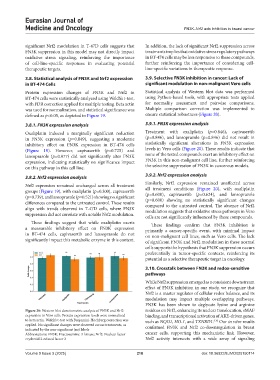
            3.8.1. FN3K expression analysis                    3.9.1. FN3K expression analysis
            Oxaliplatin induced a marginally significant reduction   Treatment with oxaliplatin (p=0.846), capivasertib
            in FN3K expression (p=0.049), suggesting a moderate   (p=0.846), and lansoprazole (p=0.846) did not result in
            inhibitory effect on FN3K expression in BT-474  cells   statistically significant alterations in FN3K expression
            (Figure  19).  However,  capivasertib  (p=0.725)  and   levels in Vero cells (Figure 20). These results indicate that
            lansoprazole (p=0.077) did not significantly alter FN3K   none of the tested compounds exert an inhibitory effect on
            expression, indicating statistically no significance impact   FN3K in this non-malignant cell line, further reinforcing
            on this pathway in this cell line.                 the selective suppression of FN3K in cancerous models.
            3.8.2. Nrf2 expression analysis                    3.9.2. Nrf2 expression analysis
                                                               Similarly, Nrf2 expression remained unaffected across
            Nrf2 expression remained unchanged across all treatment   all treatment conditions (Figure  20), with oxaliplatin
            groups (Figure 19), with oxaliplatin (p=0.300), capivasertib   (p=0.600), capivasertib (p=0.624), and lansoprazole
            (p=0.739), and lansoprazole (p=0.521) showing no significant   (p=0.600) showing no statistically significant changes
            differences compared to the untreated control. These results   compared to the untreated control. The absence of Nrf2
            align with trends observed in T-47D cells, where FN3K   modulation suggests that oxidative stress pathways in Vero
            suppression did not correlate with notable Nrf2 modulation.  cells are not significantly influenced by these compounds.
              These findings suggest that while oxaliplatin exerts   These findings confirm that FN3K inhibition is
            a  measurable  inhibitory  effect  on FN3K  expression   primarily a cancer-specific event, with minimal impact
            in BT-474  cells, capivasertib and lansoprazole do not   on non-malignant cell lines, such as Vero cells. The lack
            significantly impact this metabolic enzyme in this context.   of significant FN3K and Nrf2 modulation in these normal
                                                               cells supports the hypothesis that FN3K suppression occurs
                                                               preferentially in tumor-specific contexts, reinforcing its
                                                               potential as a selective therapeutic target in oncology.
                                                               3.10. Crosstalk between FN3K and redox-sensitive
                                                               pathways
                                                               While Nrf2 suppression emerged as a consistent downstream
                                                               effect of FN3K inhibition in our study, we recognize that
                                                               Nrf2 is a master regulator of cellular redox balance, and its
                                                               modulation  may  impact  multiple  overlapping  pathways.
                                                               FN3K has been shown to deglycate lysine and arginine
            Figure 20: Western blot densitometric analysis of FN3K and Nrf2   residues on Nrf2, enhancing its nuclear translocation, sMAF
            expression in Vero cells. Protein expression levels were normalized   binding, and transcriptional activation of ARE-driven genes,
            to beta actin. Welch’s t-test with Benjamini-Hochberg correction was   such as NQO1, HO-1, and TXNRD1.  Our in vitro results
                                                                                            3,10
            applied. No significant changes were observed across treatments, as   confirmed FN3K and Nrf2 co-downregulation in breast
            indicated by the non-significant (ns) labels
            Abbreviations: FN3K: Fructosamine-3-kinase; Nrf2: Nuclear factor   cancer cells, supporting this mechanistic link. However,
            erythroid 2-related factor 2                       Nrf2 activity intersects with a wide array of signaling


            Volume 9 Issue 3 (2025)                        218                         doi: 10.36922/EJMO025150114

