


Page 220 - EJMO-9-3
P. 220
Eurasian Journal of
            Medicine and Oncology                                              FN3K–Nrf2 axis inhibition in breast cancer


            (p<0.001;  Figure  7). The strong statistical significance
            across these treatments suggests that these compounds
            act as potent FN3K inhibitors in BT-474 cells, consistent
            with findings in other breast cancer models. This
            reinforces their potential as effective FN3K-targeting
            agents.

            3.3.3.2. Nrf2 expression analysis
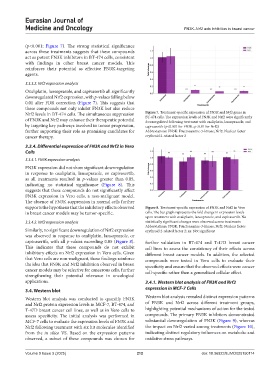
            Oxaliplatin, lansoprazole, and capivasertib all significantly
            downregulated Nrf2 expression, with p-values falling below
            0.01 after FDR correction  (Figure  7). This suggests that
            these compounds not only inhibit FN3K but also reduce
            Nrf2 levels in BT-474 cells. The simultaneous suppression   Figure 7. Treatment-specific expression of FN3K and Nrf2 genes in
                                                               BT-474 cells. The expression levels of FN3K and Nrf2 were significantly
            of FN3K and Nrf2 may enhance their therapeutic potential   downregulated following treatment with oxaliplatin, lansoprazole, and
            by targeting key pathways involved in tumor progression,   capivasertib (p<0.001 for FN3K; p<0.01 for Nrf2)
            further supporting their role as promising candidates for   Abbreviations: FN3K: Fructosamine-3-kinase; Nrf2: Nuclear factor
            cancer therapy.                                    erythroid 2-related factor 2
            3.3.4. Differential expression of FN3K and Nrf2 in Vero
            Cells
            3.3.4.1. FN3K expression analysis
            FN3K expression did not show significant downregulation
            in  response  to oxaliplatin,  lansoprazole,  or  capivasertib,
            as all treatments resulted in  p-values greater than 0.05,
            indicating  no  statistical  significance  (Figure  8).  This
            suggests that these compounds do not significantly affect
            FN3K  expression  in  Vero  cells,  a  non-malignant  model.
            The absence of FN3K suppression in normal cells further
            supports the hypothesis that the inhibitory effects observed   Figure 8. Treatment-specific expression of FN3K and Nrf2 in Vero
            in breast cancer models may be tumor-specific.     cells. The bar graph represents the fold change in expression levels
                                                               upon treatment with oxaliplatin, lansoprazole, and capivasertib. No
            3.3.4.2. Nrf2 expression analysis                  statistically significant changes were observed across treatments
                                                               Abbreviations: FN3K: Fructosamine-3-kinase; Nrf2: Nuclear factor
            Similarly, no significant downregulation of Nrf2 expression   erythroid 2-related factor 2; ns: Not significant
            was observed in response to oxaliplatin, lansoprazole, or
            capivasertib, with all p-values exceeding 0.05 (Figure 8).   further validation in BT-474 and T-47D breast cancer
            This indicates  that these compounds do not exhibit   cell lines to assess the consistency of their effects across
            inhibitory effects on Nrf2 expression in Vero cells. Given   different breast cancer models. In addition, the selected
            that Vero cells are non-malignant, these findings reinforce   compounds were tested in Vero cells to evaluate their
            the idea that FN3K and Nrf2 inhibition observed in breast   specificity and ensure that the observed effects were cancer
            cancer models may be selective for cancerous cells, further   cell-specific rather than a generalized cellular effect.
            strengthening their potential relevance in oncological
            applications.                                      3.4.1. Western blot analysis of FN3K and Nrf2
            3.4. Western blot                                  expression in MCF-7 Cells
            Western blot analysis was conducted to quantify FN3K   Western blot analysis revealed distinct expression patterns
            and Nrf2 protein expression levels in MCF-7, BT-474, and   of FN3K and Nrf2 across different treatment groups,
            T-47D breast cancer cell lines, as well as in Vero cells to   highlighting potential mechanisms of action for the tested
            assess specificity. The initial analysis was performed in   compounds. The primary FN3K inhibitors demonstrated
            MCF-7 cells to evaluate the expression levels of FN3K and   substantial downregulation of FN3K (Figure 9), whereas
            Nrf2 following treatment with six hit molecules identified   the impact on Nrf2 varied among treatments (Figure 10),
            from the  in silico VS. Based on the expression patterns   indicating distinct regulatory influences on metabolic and
            observed, a  subset  of  these  compounds was  chosen  for   oxidative stress pathways.


            Volume 9 Issue 3 (2025)                        212                         doi: 10.36922/EJMO025150114

