


Page 15 - ESAM-1-4
P. 15
Engineering Science in
            Additive Manufacturing                                                       Experimental statistics in AM


                         A                                   B


                         C


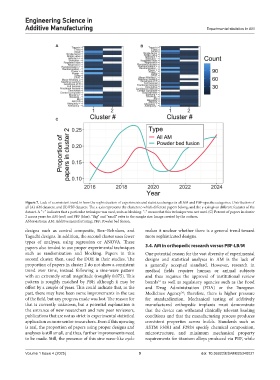
            Figure 7. Lack of a consistent trend in how the sophistication of experiments and statistics changes in all AM and PBF-specific categories. Distribution of
            all (A) AM datasets, and (B) PBF datasets. The x-axis represents the clusters to which different papers belong, and the y-axis gives different features of the
            dataset. A “+” indicates that a particular technique was used, such as blocking. “-“ means that this technique was not used. (C) Percent of papers in cluster
            2 across years for AM (red) and PBF (blue). “Big” and “small” refer to the sample size. Image created by the authors.
            Abbreviations: AM: Additive manufacturing; PBF: Powder bed fusion.
            designs such as central composite, Box–Behnken, and   makes it unclear whether there is a general trend toward
            Taguchi designs. In addition, the second cluster uses fewer   more sophisticated designs.
            types  of  analyses,  using  regression  or  ANOVA.  These
            papers also tended to use proper experimental techniques   3.4. AM in orthopedic research versus PBF-LB/M
            such as randomization and blocking. Papers in this   One potential reason for the vast diversity of experimental
            second cluster, then, used the DOE in their studies. The   designs and statistical analyses in AM is the lack of
            proportion of papers in cluster 2 do not show a consistent   a generally accepted standard. However, research in
            trend over time, instead following a sine-wave pattern   medical fields requires human or animal subjects
            with an extremely small magnitude (roughly 0.075). This   and  thus  requires  the  approval  of  institutional  review
            pattern is roughly matched by PBF, although it may be   boards  as well as regulatory agencies such as the Food
                                                                    33
            offset by a couple of years. This could indicate that, in the   and Drug Administration (FDA) or the European
            past, there may have been some improvements in the use   Medicines Agency ; therefore, there is higher pressure
                                                                              34
            of the field, but any progress made was lost. The reason for   for standardization. Mechanical testing of additively
            that is currently unknown, but a potential explanation is   manufactured orthopedic implants must demonstrate
            the entrance of new researchers and new peer reviewers,   that the device can withstand clinically relevant loading
            publications that are not as strict in experimental statistical   conditions and that the manufacturing process produces
            application as more senior researchers. Even if this upswing   consistent properties across builds. Standards such as
            is real, the proportion of papers using proper designs and   ASTM F3001 and F2924 specify chemical composition,
            analyses is still small, and thus, further improvements need   microstructure, and minimum mechanical property
            to be made. Still, the presence of this sine wave-like cycle   requirements for titanium alloys produced via PBF, while


            Volume 1 Issue 4 (2025)                         9                          doi: 10.36922/ESAM025340021

