


Page 72 - GHES-1-1
P. 72
Global Health Econ Sustain Implication of close contact
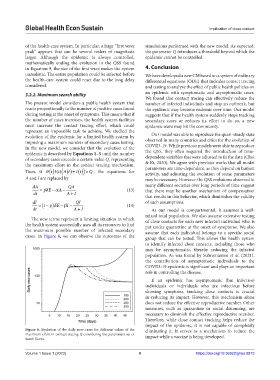
of the health-care system. In particular, a large “first wave simulations performed with the new model. As expected,
peak” appears that can be several orders of magnitude the parameter Q introduces a threshold beyond which the
larger. Although the epidemic is always controlled, epidemic cannot be controlled.
mathematically ending the evolution in the QSS found
in Equation 9, the size of the first wave makes the system 4. Conclusion
unrealistic. The entire population could be infected before We have developed a new CM based on a system of ordinary
the health-care system could react due to the long delay differential equations (ODE) that includes contact tracing
considered. and testing to analyze the effect of public health policies on
3.2.2. Maximum search ability an epidemic with symptomatic and asymptomatic cases.
We found that contact tracing can effectively reduce the
The present model considers a public health system that number of infected individuals and stop an outbreak, but
reacts proportionally to the number of positive cases found the epidemic may become endemic over time. Our model
during testing at the onset of symptoms. This means that if suggests that if the health system suddenly stops tracking
the number of cases increases, the health system facilities secondary cases or reduces its effort to do so, a new
must increase the contact tracing effort, which could epidemic wave may hit the community.
represent an impossible task to achieve. We studied the
evolution of the epidemic for a limited health system by Our model was able to reproduce the quasi-steady state
imposing a maximum number of secondary cases testing. observed in many countries and cities for the evolution of
In the new model, we consider that the evolution of the COVID-19. While previous models were able to reproduce
epidemic is described by Equations 1–5 until the number the QSS, they often required the introduction of time-
of secondary cases exceeds a certain value Q, representing dependent variables that were adjusted to fit the data (Choi
the maximum effort in the contact tracing mechanism. & Ki, 2020). We agree with previous works that all model
parameters are time-dependent, as they depend on human
() (
Then, if tI tA t () + ()) >() I t Q , the equations for activity, and adjusting the evolution of some parameters
A and I are replaced by may be necessary. However, the QSS evolutions observed in
dA = pE −δ α A − QA (13) many different societies over long periods of time suggest
dt AI+ that there may be another mechanism of compensation
that results in this behavior, which diminishes the validity
dI =(1 − ) β I − QI (14) of such assumptions.
pE −δ
dt AI+ As our model is compartmental, it assumes a well-
mixed total population. We also assume extensive testing
The new terms represent a limiting situation in which of close contacts for each new infected individual who is
the health system successfully uses all its resources to find put under quarantine at the onset of symptoms. We also
the maximum possible number of infected secondary assume that each individual belongs to a specific social
cases. In Figure 6, we can observe the outcomes of the group that can be tested. This allows the health system
to identify infected close contacts, including those who
may be asymptomatic, thereby reducing the infected
population. As was found by Subramanian et al. (2021),
the contribution of asymptomatic individuals to the
COVID-19 epidemic is significant and plays an important
role in controlling the disease.
If an epidemic has asymptomatic (but infective)
individuals or individuals who are infectious before
showing symptoms, tracking close contacts is crucial
in reducing its impact. However, this mechanism alone
does not reduce the effective reproductive number. Other
measures, such as quarantine or social distancing, are
necessary to diminish the effective reproductive number.
Therefore, while close contact tracking helps reduce the
impact of the epidemic, it is not capable of completely
Figure 6. Evolution of the daily new cases for different values of the eliminating it. It serves as a mechanism to reduce the
maximum effort in contact tracing Q considering the parameters set of impact while a vaccine is being developed.
South Korea.
Volume 1 Issue 1 (2023) 9 https://doi.org/10.36922/ghes.0873

