


Page 69 - GHES-1-1
P. 69
Global Health Econ Sustain Implication of close contact
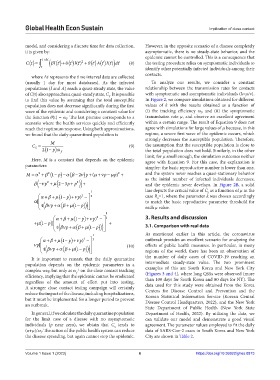
model, and considering a discrete time for data collection, However, in the opposite scenario of a disease completely
it is given by: asymptomatic, there is no steady-state behavior, and the
epidemic cannot be controlled. This is a consequence that
t+∆
t
θ '
Ct () = ∫ t ( β It () + () () 2 + () () ' ' (8) the testing procedure relies on symptomatic individuals to
t At It dt ) '()
θ
'
'
tI t'
identify other potentially infected individuals among their
contacts.
where ∆t represents the time interval data are collected
(usually 1 day for most databases). As the infected To analyze our results, we consider a constant
populations (I and A) reach a quasi-steady state, the value relationship between the transmission rates for contacts
of C(t) also approaches a quasi-steady state, C . It is possible with symptomatic and asymptomatic individuals (k=μ/ν).
S
to find this value by assuming that the total susceptible In Figure 2, we compare simulations obtained for different
population does not decrease significantly during the first values of k with the results obtained as a function of
wave of the epidemic and considering a constant value for (i) the tracking efficiency ω f, and (ii) the symptomatic
the function θ(t) = ω f. The last premise corresponds to a transmission rate µ, and observe an excellent agreement
scenario where the health services quickly and efficiently within a certain range. The result of Equation 9 does not
reach their optimum response. Using both approximations, agree with simulations for large values of µ because, in this
we found that the daily quarantined population is regime, a severe first wave of the epidemic occurs, which
strongly decreases the susceptible population. Therefore,
M
C = − ( 21 p) (9) the assumption that the susceptible population is close to
S
the total population does not hold. Similarly, in the other
f
limit, for µ small enough, the simulation outcomes neither
Here, M is a constant that depends on the epidemic agree with Equation 9. For this case, the explanation is
parameters: simpler: the basic reproductive number is lower than one,
2
αβ
M = α 2 + (1 − p) − ( − ν 2 p ) + µ ν p − µ p +) 2 and the system never reaches a quasi-stationary behavior
β
+
(
as the initial number of infected individuals decreases,
2
2
µ
+
β ( −ν p + ( 23 p p )) + and the epidemic never develops. In Figure 2B, a solid
−
1 line depicts the critical value of C as a function of µ in the
S
α ++ µµ 1− ( p ) + ν p) 2 − 2 case R =1, where the parameter k was chosen accordingly
β
0
α[ to match the basic reproductive parameter threshold for
αβ + (
4( βν + ( µ 1− ))) each µ value.
p
p
1
α ++ ( 2 − 2 3. Results and discussion
µ 1− p)) +ν p)
β
+ µ 1− ( ) p [ +
p
4 ( βν p + ( + (1 − ))) 3.1. Comparison with real data
αβ
µ
1 As mentioned earlier in this article, the coronavirus
α ++ (1 − ) +ν p) 2 − 2 outbreak provides an excellent scenario for analyzing the
β
µ
p
ν p[ 4( p))) (10) effects of public health measures. In particular, in many
α β + (1
βνν p + ( µ − regions of the world, there has been an observation of
It is important to remark that the daily quarantine the number of daily cases of COVID-19 reaching an
population depends on the epidemic parameters in a intermediate steady-state value. The two prominent
complex way, but only as ω on the close contact tracking examples of this are South Korea and New York City
-1
f
efficiency, implying that the epidemic cannot be eradicated (Figures 3 and 4), where long QSSs were observed (more
regardless of the amount of effort put into testing. than 100 days for South Korea and 80 days for NY). The
data used for this study were obtained from the Korea
A stronger close contact testing campaign will certainly Centers for Disease Control and Prevention and the
reduce the impact of the disease, including hospitalizations, Korean Statistical Information Service (Korean Central
but it must be implemented for a longer period to prevent Disease Control Headquarters, 2022), and the New York
an outbreak.
State Department of Public Health (New York State
In general, if we calculate the daily quarantine population Department of Health, 2022). By utilizing the data, we
for the limit case of a disease with no asymptomatic can validate our model and demonstrate a good visual
individuals (p near zero), we obtain that C tends to agreement. The parameter values employed to fit the daily
S
(α+μ)/ω f. The action of the public health system can reduce data of SARS-Cov-2 cases in South Korea and New York
the disease spreading, but again cannot stop the epidemic. City are shown in Table 2.
Volume 1 Issue 1 (2023) 6 https://doi.org/10.36922/ghes.0873

