


Page 45 - GHES-1-2
P. 45
Global Health Econ Sustain                                 Social support and health in musculoskeletal disorders


              In this study, a semi-structured questionnaire was   responsible for human experimentation (institutional and
            used, covering five sections: (i) The first section concerns   national), and the Declaration of Helsinki 1975.
            demographic data of the sample (sex, age, marital status,   Statistical analysis was performed using descriptive
            number of children, education level, professional status,   statistics  and  inductive  statistics.  Descriptive  statistics
            type of professional work, number of family members in   captured the demographics of the sample as well as their
            the same household, paid/unpaid helper, financial status,   responses to the core survey section. In addition, through
            place of residence, and insurance cover). (ii) The second   inductive statistics, the relationships between the variables
            section concerns the state of health (duration treatment of   were examined. The statistical program IBM SPSS v.22.0
            musculoskeletal health problems, taking medication for   and Microsoft Office Excel were used for the analysis.
            treatment of musculoskeletal health problems, duration of
            taking medications for the treatment of musculoskeletal   3. Results
            health problems, and severity of musculoskeletal health
            problems). (iii) The third section concerns the perceived   This study included 106 elderly people with musculoskeletal
            social support (based on the Multidimensional Scale of   diseases, of which 32 (30.2%) were men and 74 (69.8%)
            Perceived  Social  Support,  MSPSS)  (Zimet  et  al.,  1988).   were women (Table 1).
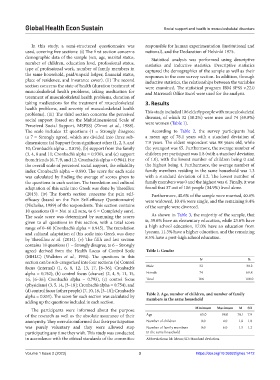
            The scale includes 12 questions (1 = Strongly disagree;   According to  Table 2, the survey participants had
            to 7 = Strongly agree), which are divided into three sub-  a mean age of 76.1  years with a standard deviation of
            dimensions: (a) Support from significant other (1, 2, 5, and   7.9 years. The oldest respondent was 98 years old, while
            10; Cronbach’s alpha = 0.876), (b) support from the family   the youngest was 65. Furthermore, the average number of
            (3, 4, 8 and 11; Cronbach’s alpha = 0.930), and (c) support   children per participant was 1.8 (with a standard deviation
            from friends (6, 7, 9, and 12; Cronbach’s alpha = 0.964). For   of 1.0), with the lowest number of children being 0 and
            the overall scale of perceived social support, the reliability   the highest being 4. Furthermore, the average number of
            index Cronbach’s alpha = 0.890. The score for each scale   family members residing in the same household was 1.3
            was calculated by finding the average of scores given to   with a standard deviation of 1.2. The lowest number of
            the questions in each section. The translation and cultural   family members was 0 and the highest was 6. Finally, it was
            adaptation of this scale into Greek was done by Theofilou   found that 37 out of 106 people (34.9%) lived alone.
            (2015). (iv) The fourth section concerns the pain self-  Furthermore, 40.6% of the sample were married, 40.6%
            efficacy (based on the Pain Self-efficacy Questionnaire)   were widowed, 10.4% were single, and the remaining 8.4%
            (Nicholas, 1989) of the respondents. This section contains   of the sample were divorced.
            10 questions (0 = Not at all sure, to 6 = Completely sure).
            The scale score was determined by summing the scores   As shown in Table 3, the majority of the sample, that
            given to all questions in this section, with a total score   is, 39.6% have an elementary education, while 23.6% have
            range of 0–60 (Cronbach’s alpha = 0.945). The translation   a high school education, 17.0% have an education from
            and cultural adaptation of this scale into Greek was done   lyceum, 11.3% have a higher education, and the remaining
            by Theofilou  et al. (2014). (v) The fifth and last section   8.5% have a post-high school education.
            contains 18 questions (1 = Strongly disagree, to 6 = Strongly
            agree) derived from the Health Locus of Control Scale   Table 1: Gender
            (MHLC) (Wallston  et al., 1994). The questions in this
            section can be sub-categorized into four sections: (a) Control            Ν                   %
            focus (internal) (1, 6, 8, 12, 13, 17, [6–36]; Cronbach’s   Male          32                  30.2
            alpha = 0.762), (b) control focus (chance) (2, 4, 9, 11, 15,   Female     74                  69.8
            16,  [6–36];  Cronbach’s  alpha  =  0.793),  (c) control focus   Total   106                 100.0
            (physicians) (3, 5, 14, [3–18]; Cronbach’s alpha = 0.754), and
            (d) control focus (other people) (7, 10, 18, [3–18]; Cronbach’s
            alpha = 0.851). The score for each section was calculated by   Table 2. Age, number of children, and number of family
                                                               members in the same household
            adding up the questions included in each section.
              The participants were informed about the purpose                      Minimum  Maximum   Μ  SD
            of the research as well as the absolute assurance of their   Age          65.0     98.0   76.1  7.9
            anonymity. They were also informed that their participation   Number of children  0.0  4.0  1.8  1.0
            was purely voluntary and they were allowed stop    Number of family members   0.0   6.0   1.3  1.2
            participating any time they wish. This study was conducted   in the same household
            in accordance with the ethical standards of the committee   Abbreviations: M: Mean; SD: Standard deviation.


            Volume 1 Issue 2 (2023)                         3                        https://doi.org/10.36922/ghes.1412

