


Page 46 - GHES-1-2
P. 46
Global Health Econ Sustain                                 Social support and health in musculoskeletal disorders


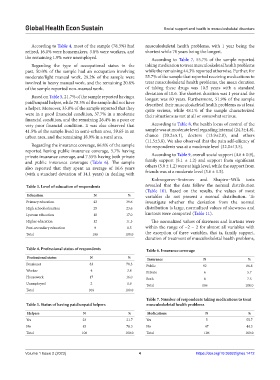
              According to Table 4, most of the sample (78.3%) had   musculoskeletal health problems, with 1  year being the
            retired, 16.0% were homemakers, 3.8% were workers, and   shortest while 70 years being the longest.
            the remaining 1.9% were unemployed.                  According  to  Table  7,  55.7%  of the sample reported

              Regarding the type of occupational status in the   taking medication to treat musculoskeletal health problems
            past, 50.0% of the sample had an occupation involving   while the remaining 44.3% reported otherwise. Further, for
            moderate/light manual work, 29.2% of the sample were   55.7% of the sample that reported receiving medications to
            involved in heavy manual work, and the remaining 20.8%   treat musculoskeletal health problems, the mean duration
            of the sample reported non-manual work.            of taking these drugs was 10.5  years with a standard
                                                               deviation of 10.6. The shortest duration was 1 year and the
              Based on Table 5, 21.7% of the sample reported having a   longest was 60 years. Furthermore, 51.9% of the sample
            paid/unpaid helper, while 78.3% of the sample did not have   described their musculoskeletal health problems as at least
            a helper. Moreover, 35.8% of the sample reported that they   quite serious, while 48.1% of the sample characterized
            were in a good financial condition, 37.7% in a moderate   their situations as not at all or somewhat serious.
            financial condition, and the remaining 26.4% in a poor or
            very poor financial condition. It was also observed that   According to Table 8, the health locus of control of the
            41.5% of the sample lived in semi-urban area, 39.65 in an   sample was at moderate level regarding internal (24.3±4.8),
            urban area, and the remaining 18.9% in a rural area.  chance (20.2±5.1), doctors (13.9±2.8), and others
                                                               (11.5±3.8). We also observed that the pain self-efficacy of
              Regarding the insurance coverage, 86.8% of the sample   the respondents was at a moderate level (32.0±13.5).
            reported having public insurance coverage, 5.7% having
            private insurance coverage, and 7.55% having both private   According to Table 9, overall social support (4.6 ± 0.9),
            and public insurance coverages (Table 6). The sample   family support (5.1 ± 1.2) and support from significant
            also reported that  they spent an average of 16.6  years   others (5.0 ± 1.2) were at high level, while the support from
            (with a standard deviation of 14.1 years) in dealing with   friends was at a moderate level (3.6 ± 1.5).
                                                                 Kolmogorov–Smirnov   and   Shapiro–Wilk  tests
            Table 3. Level of education of respondents         revealed  that  the  data  follow  the  normal  distribution
                                                               (Table  10). Based on the results, the values of most
             Education                   Ν             %       variables do not present a normal distribution. To
            Primary education            42            39.6    investigate whether the  deviation from  the normal
            High school education        25            23.6    distribution is large, normalized values of skewness and
            Lyceum education             18            17.0    kurtosis were computed (Table 11).
            Higher education             12            11.3      The normalized values of skewness and kurtosis were
            Post-secondary education     9             8.5     within  the range  of  −2 – 2  for almost  all variables  with
            Total                       106           100.0    the exception of three variables, that is, family support,
                                                               duration of treatment of musculoskeletal health problems,
            Table 4. Professional status of respondents        Table 6. Insurance coverage

             Professional status       Ν               %        Insurance               Ν                 %
            Pensioner                  83              78.3    Public                  92                 86.8
            Worker                      4              3.8     Private                  6                 5.7
            Housework                  17              16.0    Both                     8                 7.5
            Unemployed                  2              1.9     Total                   106               100.0
            Total                      106            100.0

                                                               Table 7. Number of respondents taking medications to treat
            Table 5. Status of having paid/unpaid helpers      musculoskeletal health problems
             Helpers                Ν                  %        Medications             Ν                  %
            Yes                     23                 21.7    Yes                       5                55.7
            No                      83                 78.3    No                       47                44.3
            Total                   106               100.0    Total                    106              100.0


            Volume 1 Issue 2 (2023)                         4                        https://doi.org/10.36922/ghes.1412

