


Page 49 - GHES-1-2
P. 49
Global Health Econ Sustain                                 Social support and health in musculoskeletal disorders


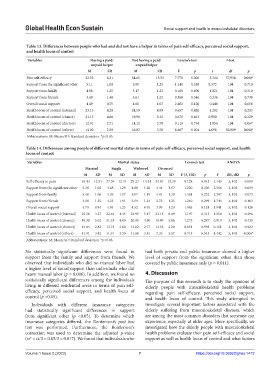
            Table 13. Differences between people who had and did not have a helper in terms of pain self‑efficacy, perceived social support,
            and health locus of control
             Variables                 Having a paid/    Not having a paid/  Levene’s test       t‑test
                                        unpaid helper      unpaid helper
                                      Μ        SD         Μ         SD       F      p      t      df      p
            Pain self-efficacy       22.52    8.31       34.65     13.55   7.770  0.006  −5.314  57,934  0.000*
            Support from the significant other  5.11  1.00  5.00    1.25   1.141  0.288   0.373   104    0.710
            Support from family       4.88    1.25       5.17       1.22   0.160  0.690  −1.021   104    0.310
            Support from friends      3.49    1.48       3.61       1.52   0.368  0.546  −0.336   104    0.738
            Overall social support    4.49    0.75       4.60       1.03   2.463  0.120  −0.446   104    0.656
            Health locus of control (internal)  23.13  4.20  24.59  4.99   0.657  0.420  −1.282   104    0.203
            Health locus of control (chance)  21.13  4.66  19.96    5.15   0.676  0.413   0.980   104    0.329
            Health locus of control (doctors)  12.91  2.71  14.12   2.78   0.116  0.734  −1.854   104    0.067
            Health locus of control (others)  14.00  2.58  10.82    3.76   8.667  0.004   4.698  50.809  0.000*
            Abbreviations: M: Mean; SD: Standard deviation. *p<0.05.

            Table 14. Differences among people of different marital status in terms of pain self‑efficacy, perceived social support, and health
            locus of control
             Variables                             Marital status               Levene’s test     ANOVA
                                     Married    Single    Widowed   Divorced
                                     Μ    SD   Μ    SD    Μ    SD   Μ    SD   F (3, 102)  p  F   df1, df2  p
            Self-efficacy in pain   35.44  12.51  27.36  12.41  29.23  14.24  34.67  13.39  0.128  0.943  2.143  3, 102  0.099
            Support from the significant other  5.38  1.02  4.68  1.29  4.88  1.20  4.44  1.57  1.220  0.306  2.566  3, 102  0.059
            Support from family     5.40  1.06  4.39  1.57  5.07  1.19  4.81  1.39  1.454  0.232  2.387  3, 102  0.073
            Support from friends    3.58  1.55  4.25  1.91  3.59  1.34  2.72  1.25  1.240  0.299  1.744  3, 102  0.163
            Overall social support  4.79  0.84  4.44  1.23  4.52  0.93  3.99  1.29  1.963  0.124  1.941  3, 102  0.128
            Health locus of control (internal)  25.26  4.27  22.64  4.43  23.95  5.17  23.11  6.09  1.197  0.315  1.250  3, 102  0.296
            Health locus of control (chance)  19.30  5.62  21.18  4.00  20.95  4.50  19.89  5.86  1.275  0.287  0.919  3, 102  0.435
            Health locus of control (doctors)  13.84  2.82  13.73  2.80  14.02  2.77  13.33  3.20  0.031  0.993  0.161  3, 102  0.923
            Health locus of control (others)  11.91  3.42  11.91  3.30  11.88  3.81  7.33  3.57  0.715  0.545  4.442  3, 102  0.006*
            Abbreviations: M: Mean; SD: Standard deviation. *p<0.05.

            No statistically significant differences were found in   had both private and public insurance showed a higher
            support from the family and support from friends. We   level of support from the significant other than those
            observed that individuals who did no manual labor had   covered by public insurance only (p = 0.011).
            a higher level of social support than individuals who did
            heavy manual labor (p = 0.006). In addition, we found no   4. Discussion
            statistically significant differences among the individuals   The purpose of this research is to study the opinions of
            living in different residential areas in terms of pain self-  elderly people with musculoskeletal health problems
            efficacy,  perceived  social  support,  and  health  locus  of   regarding pain self-efficacy, perceived social support,
            control (p >0.05).                                 and health locus of control. This study attempted to
              Individuals with different insurance categories   investigate several important factors associated with the
            had statistically significant differences in support   elderly suffering from musculoskeletal diseases, which
            from significant other (p <0.05). To determine which   are among the most common disorders that someone can
            insurance categories differed, the Bonferroni’s  post hoc   experience, especially at older ages. More specifically, we
            test was performed. Furthermore, the Bonferroni’s   investigated how the elderly people with musculoskeletal
            correction was used to determine the adjusted  p-value   health problems evaluate their pain self-efficacy and social
            (α* = α/3 = 0.05/3 = 0.017). We found that individuals who   support as well as health locus of control and what factors


            Volume 1 Issue 2 (2023)                         7                        https://doi.org/10.36922/ghes.1412

