


Page 47 - GHES-1-2
P. 47
Global Health Econ Sustain                                 Social support and health in musculoskeletal disorders


            Table 8. Health locus of control of respondents
             Dimensions                 Minimum value      Maximum value      Μ        SD        Range scale (Μ)
            Health locus of control (internal)  15.0           36.0          24.3      4.8         6 – 36 (21)
            Health locus of control (chance)  6.0              29.0          20.2      5.1         6 – 36 (21)
            Health locus of control (doctors)  6.0             18.0          13.9      2.8         3 – 18 (10,5)
            Health locus of control (others)  3.0              18.0          11.5      3.8         3 – 18 (10,5)
            Abbreviations: M: Mean; SD: Standard deviation.

            Table 9. Perceived social support of the respondents
             Subscales                Minimum value     Maximum value       Μ          SD        Range scale (Μ)
            Support from significant others  2.0            7.0             5.0        1.2          1–7 (4)
            Support from family           1.0               7.0             5.1        1.2          1–7 (4)
            Support from friends          1.0               7.0             3.6        1.5          1–7 (4)
            Overall social support        2.0               6.6             4.6        0.9          1–7 (4)
            Abbreviations: M: Mean; SD, standard deviation.

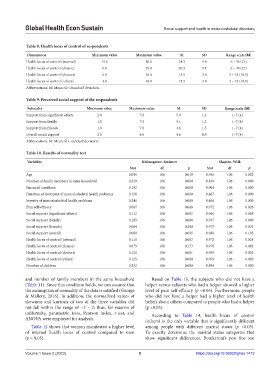
            Table 10. Results of normality test
             Variables                                       Kolmogorov–Smirnov               Shapiro–Wilk
                                                        Stat         df          p       Stat     df       p
            Age                                         0.096        106        0.019    0.956    106    0.002
            Number of family members in same household  0.229        106        0.000    0.839    106    0.000
            Financial condition                         0.192        106        0.000    0.904    106    0.000
            Duration of treatment of musculoskeletal health problems  0.158  106  0.000  0.867    106    0.000
            Severity of musculoskeletal health problems  0.241       106        0.000    0.866    106    0.000
            Pain self-efficacy                          0.087        106        0.048    0.972    106    0.026
            Social support (significant others)         0.112        106        0.002    0.966    106    0.008
            Social support (family)                     0.105        106        0.006    0.937    106    0.000
            Social support (friends)                    0.064        106        0.200    0.973    106    0.032
            Social support (overall)                    0.080        106        0.095    0.980    106    0.105
            Health locus of control (internal)          0.111        106        0.003    0.972    106    0.024
            Health locus of control (chance)            0.075        106        0.173    0.978    106    0.082
            Health locus of control (doctors)           0.121        106        0.001    0.959    106    0.003
            Health locus of control (others)            0.125        106        0.000    0.956    106    0.002
            Number of children                          0.252        106        0.000    0.894    106    0.000

            and number of family members in the same household   Based on  Table  13, the subjects who did not have a
            (Table 11). Since this condition holds, we can assume that   helper versus subjects who had a helper showed a higher
            the assumption of normality of the data is satisfied (George   level of pain self-efficacy (p <0.05). Furthermore, people
            & Mallery, 2016). In addition, the normalized values of   who did not have a helper had a higher level of health
            skewness and kurtosis of two of the three variables did   beliefs about others compared to people who had a helper
            not  fall  within  the  range  of  −2  – 2;  thus,  for  reasons  of   (p <0.05).
            uniformity, parametric tests, Pearson index,  t-test, and   According to  Table  14, health locus of control
            ANOVA were employed for analysis.                  (others) is the only variable that is significantly different
              Table 12 shows that women manifested a higher level   among  people  with  different  marital  status  (p  <0.05).
            of internal health locus of control compared to men   To exactly determine the marital status categories that
            (p < 0.05).                                        show significant differences, Bonferroni’s  post hoc test


            Volume 1 Issue 2 (2023)                         5                        https://doi.org/10.36922/ghes.1412

