


Page 50 - GHES-1-2
P. 50
Global Health Econ Sustain                                 Social support and health in musculoskeletal disorders


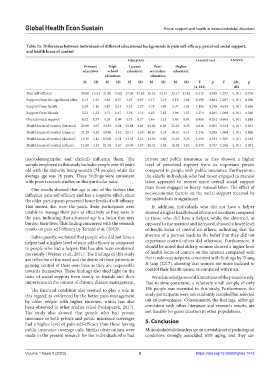
            Table 15. Differences between individuals of different educational backgrounds in pain self‑efficacy, perceived social support,
            and health locus of control
                                                       Education                    Levene’s test   ANOVA
                                     Primary   High     Lyceum    Post‑     Higher
                                    education   school   education   secondary   education
                                              education          education
                                    Μ    SD   Μ   SD   Μ    SD   Μ   SD    Μ   SD     F    p    F   df1,   p
                                                                                    (4, 101)         df2
            Pain self-efficacy     29.00 13.54 31.80 14.62 37.00 11.63 35.22  13.31  33.17 13.16  0.215  0.930 1.297  4, 101  0.276
            Support from the significant other  5.13  1.25  4.56  1.27  5.25  0.97  5.17  1.19  5.19  1.08  0.290  0.884 1.287  4, 101  0.280
            Support from family     5.20  1.16  4.87  1.15  5.24  1.27  4.78  1.84  5.37  1.01  1.106  0.358 0.639  4, 101  0.636
            Support from friends    3.23  1.61  3.71  1.47  3.76  1.14  4.03  1.63  3.96  1.51  1.274  0.285 1.090  4, 101  0.366
            Overall social support  4.52  0.97  4.38  1.08  4.75  0.77  4.66  1.14  4.84  0.94  0.806  0.524 0.665  4, 101  0.618
            Health locus of control (internal)  23.69  4.67  24.24  4.94  24.94  4.84  24.44  6.64  25.25  4.33  0.836  0.505 0.354  4, 101  0.841
            Health locus of control (chance)  21.29  5.50  19.80  4.16  20.11  4.59  18.67  4.33  18.67  6.14  1.246  0.296 1.009  4, 101  0.406
            Health locus of control (doctors)  13.19  3.12  14.68  2.34  14.33  2.14  14.56  2.46  13.25  3.25  1.550  0.194 1.585  4, 101  0.184
            Health locus of control (others)  12.69  3.54  11.36  3.67  10.00  3.97  10.22  4.44  10.92  3.03  0.470  0.757 2.206  4, 101  0.074

            (sociodemographic and clinical) influence them. The   private and public insurance as they showed a higher
            sample employed in this study includes people over 65 years   level of perceived support from an important person
            old with the majority being women (74 people), while the   compared to people with public insurance. Furthermore,
            average age was 76 years. These findings were consistent   the elderly individuals who had never engaged in manual
            with prior research studies on this particular issue.  labor appeared to receive more overall social support

              Our results showed that age is one of the factors that   than those engaged in heavy manual labor. The effect of
            influence pain self-efficacy and has a negative effect, since   socioeconomic factors on the social support received by
            the older participants presented lower levels of self-efficacy.   the individuals is significant.
            This means that over the years, these participants were   In addition, individuals who did not have a helper
            unable to manage their pain as effectively as they were in   showed a higher health locus of control on others compared
            the past, indicating that advanced age is a factor that may   to those who did have a helper, while the divorced, as
            burden their lives. This finding concurred with the research   opposed to the married and bereaved, showed a lower level
            results on pain self-efficacy by Terzaki et al. (2023).  of health locus of control on others, indicating that the
              Subsequently, we found that people who did not have a   absence of a partner leads to the belief that they did not
            helper had a higher level of pain self-efficacy as compared   experience control others did otherwise. Furthermore, it
            to people who had a helper; this has also been confirmed   should be noted that elderly women showed a higher level
            previously (Warner et al., 2011). The findings of this study   of health locus of control on the internal compared with
            are reflective of the need and the desire of these patients in   their male counterparts, consistent with findings by Zhang
            gaining control of their own lives as they are responsible   & Jang (2017), showing that women are more inclined to
            towards themselves. These findings also shed light on the   control their health issues, as compared with men.
            issue of social support from family or friends and their   We acknowledge several limitations of the present study.
            importance in the context of chronic disease management.  Due to time constraint, a relatively small sample of only
              The financial condition also seemed to play a role in   106 people was recruited in this study. Furthermore, the
            this regard, as evidenced by the better pain management   study participants were not randomly sampled but selected
            by older people with higher incomes, which has also   out of convenience. Consequently, the findings, although
            been observed in other studies (Grol-Prokopczyk, 2017).   consistent with other literature and research results, are
            The  study  also  showed  that  people  who  had  private   not feasible for generalization in other populations.
            insurance or both private and public insurance coverages   5. Conclusion
            had a higher level of pain self-efficacy than those having
            public insurance coverage only. Similar observations were   Musculoskeletal disorders are an inevitable set of pathological
            made in the present research for the individuals who had   conditions strongly associated with aging, and they can


            Volume 1 Issue 2 (2023)                         8                        https://doi.org/10.36922/ghes.1412

