


Page 55 - GHES-1-2
P. 55
Global Health Econ Sustain Antimicrobial eco-friendly material
antibiotic resistance (Khan et al., 2022; Kluytmans et al., samples in water, followed by carefully removing excess
1997). Therefore, it is crucial to inhibit their proliferation. water using absorbent paper. The weight of each sample
Finally, we conducted a comprehensive physicochemical, was recorded at predetermined time intervals. The degree
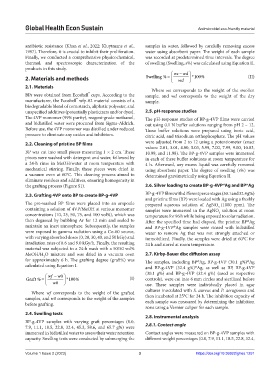
thermal, and spectroscopic characterization of the of swelling (Swelling, s%) was calculated using Equation II.
products in this study.
ws wd−
2. Materials and methods Swelling % = wd * 100 % (II)
2.1. Materials Where ws corresponds to the weight of the swollen
®
BPs were obtained from Ecoshell cups. According to the sample, and wd corresponds to the weight of the dry
®
manufacturer, the Ecoshell wfp-02 material consists of a sample.
biodegradable blend of corn starch, aliphatic polyester, and
unspecified additives (potentially plasticizers and/or dyes). 2.5. pH-response studies
The 4VP monomer (99% purity), reagent-grade methanol, The pH-response studies of BP-g-4VP films were carried
and bidistilled water were procured from Sigma-Aldrich. out using 0.1 N buffer solutions ranging from pH 2 – 12.
Before use, the 4VP monomer was distilled under reduced These buffer solutions were prepared using boric acid,
pressure to eliminate any oxides and inhibitors. citric acid, and trisodium orthophosphate. The pH values
2.2. Cleaning of pristine BP films were adjusted from 2 to 12 using a potentiometer (exact
values: 2.01, 3.01, 4.00, 5.03, 5.99, 7.00, 7.99, 9.00, 10.03,
BP was cut into small pieces measuring 1 × 2 cm. These 10.99, and 11.98). The BP-g-4VP samples were immersed
pieces were washed with detergent and water, followed by in each of these buffer solutions at room temperature for
a 24-h rinse in MeOH/water at room temperature with 4 h. Afterward, any excess liquid was carefully removed
mechanical stirring. Finally, these pieces were dried in using absorbent paper. The degree of swelling (s%) was
a vacuum oven at 60°C. This cleaning process aimed to determined gravimetrically using Equation II.
eliminate residues and additives, ensuring homogeneity in
@
@
the grafting process (Figure S1). 2.6. Silver loading to create BP-g-4VP Ag and BP Ag
2.3. Grafting 4VP onto BP to create BP-g-4VP BP-g-4VP films with different percentages (30.1 and 32.4 g%)
and pristine films (BP) were loaded with Ag using a freshly
The pre-washed BP films were placed into an ampoule prepared aqueous solution of AgNO (1000 ppm). The
3
containing a solution of 4VP/MeOH at various monomer samples were immersed in the AgNO solution at room
3
concentrations (10, 25, 50, 75, and 100 vol%), which was temperature for 96 h while being exposed to solar radiation.
then degassed by bubbling Ar for 12 min and sealed to After the specified time had elapsed, the pristine BP Ag
@
maintain an inert atmosphere. Subsequently, the samples and BP-g-4VP Ag samples were rinsed with bidistilled
@
were exposed to gamma radiation using a Co-60 source, water to remove Ag that was not strongly attached or
with varying absorbed doses (0, 20, 30, 40, and 50 kGy) and immobilized. Finally, the samples were dried at 60°C for
irradiation rates of 8.6 and 9.0 kGy/h. Finally, the resulting 24 h and stored at room temperature.
material was subjected to a 24-h wash with a 50/50 vol%
MeOH/H O mixture and was dried in a vacuum oven 2.7. Kirby-Bauer disc diffusion assay
2
for approximately 6 h. The grafting degree (graft%) was The samples, including BP Ag, BP-g-4VP (30.1 g%) Ag
@
@
calculated using Equation I. and BP-g-4VP (32.4 g%) Ag, as well as BP, BP-g-4VP
@
(30.1 g%) and BP-g-4VP (32.4 g%) (used as respective
wf − w0
Graft % = w0 * 100 % (I) controls), were cut into 6 mm circles and sterilized before
use. These samples were individually placed in agar
cultures inoculated with S. aureus and P. aeruginosa and
Where wf corresponds to the weight of the grafted
samples, and w0 corresponds to the weight of the samples then incubated at 25°C for 24 h. The inhibition capacity of
each sample was measured by determining the inhibition
before grafting.
zone using a Vernier caliper for each sample.
2.4. Swelling tests
2.8. Instrumental analysis
BP-g-4VP samples with varying graft percentages (0.0,
7.9, 11.1, 18.5, 22.8, 32.4, 45.3, 58.6, and 65.7 g%) were 2.8.1. Contact angle
immersed in bidistilled water to assess their water retention Contact angles were measured on BP-g-4VP samples with
capacity. Swelling tests were conducted by submerging the different weight percentages (0.0, 7.9, 11.1, 18.5, 22.8, 32.4,
Volume 1 Issue 2 (2023) 3 https://doi.org/10.36922/ghes.1251

