


Page 58 - GHES-1-2
P. 58
Global Health Econ Sustain                                               Antimicrobial eco-friendly material


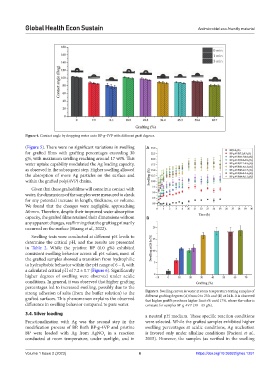
            Figure 4. Contact angle by dropping water onto BP-g-4VP with different graft degrees.

            (Figure 5). There were no significant variations in swelling   A
            for grafted films with grafting percentages exceeding 30
            g%, with maximum swelling reaching around 17 wt%. This
            water uptake capability modulated the Ag loading capacity,
            as observed in the subsequent step. Higher swelling allowed
            the absorption of more Ag particles on the surface and
            within the grafted poly(4VP) chains.
              Given that these grafted films will come into contact with
            water, the dimensions of the samples were measured to check
            for any potential increase in length, thickness, or volume.
            We found that the changes were negligible, approaching
            Δ0 mm. Therefore, despite their improved water absorption
            capacity, the grafted films retained their dimensions without   B
            any apparent changes, reaffirming that the grafting primarily
            occurred on the surface (Huang et al., 2022).
              Swelling tests were conducted at different pH levels to
            determine the  critical pH,  and  the results are  presented
            in  Table 2. While the pristine BP (0.0 g%) exhibited
            consistent swelling behavior across all pH values, most of
            the grafted samples showed a transition from hydrophilic
            to hydrophobic behavior within the pH range of 6 – 8, with
            a calculated critical pH of 7.2 ± 0.7 (Figure 6). Significantly
            higher degrees of swelling were observed under acidic
            conditions. In general, it was observed that higher grafting
            percentages led to increased swelling, possibly due to the
            strong adhesion of salts (from the buffer solution) to the   Figure 5. Swelling curves in water at room temperature testing samples of
                                                               different grafting degrees (A) from 0 to 25 h and (B) at 24 h. It is observed
            grafted surfaces. This phenomenon explains the observed   that higher graft% produces higher limit s% until 17%, where the value is
            difference in swelling behavior compared to pure water.  constant for samples BP-g-4VP (30 – 65 g%).
            3.4. Silver loading                                a neutral pH medium. These specific reaction conditions

            Functionalization with Ag was the second step in the   were selected. While the grafted samples exhibited higher
            modification process of BP. Both BP-g-4VP and pristine   swelling percentages at acidic conditions, Ag nucleation
            BP were loaded with Ag from AgNO  in a reaction    is favored only under alkaline conditions (Pacioni et al.,
                                             3
            conducted  at  room  temperature,  under  sunlight,  and  in   2015). However, the samples (as verified in the swelling

            Volume 1 Issue 2 (2023)                         6                        https://doi.org/10.36922/ghes.1251

