


Page 57 - GHES-1-2
P. 57
Global Health Econ Sustain                                               Antimicrobial eco-friendly material


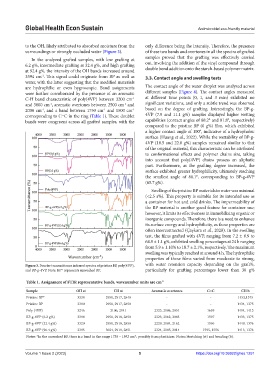
            to the OH, likely attributed to absorbed moisture from the   only difference being the intensity. Therefore, the presence
            surroundings or strongly occluded water (Figure 3).  of these two bands and overtones in all the spectra of grafted
              In the analyzed grafted samples, with low grafting at   samples proved that the grafting was effectively carried
            6.2 g%, intermediate grafting at 32.4 g%, and high grafting   out, involving the addition of the vinyl compound through
            at 92.4 g%, the intensity of the OH bands increased around   double bond addition onto the starch-based polymer matrix.
            3394 cm . This signal could originate from BP as well as   3.3. Contact angle and swelling tests
                   -1
            water, with the latter suggesting that the modified materials
            are  hydrophilic or even hygroscopic. Band assignments   The contact angle of the water droplet was analyzed across
            were further corroborated by the presence of an aromatic   different samples (Figure 4). The contact angles measured
            C-H band characteristic of poly(4VP) between 3200 cm    at different time points (0, 1, and 3  min) exhibited no
                                                         -1
            and 3000 cm , aromatic overtones between 2500 cm  and   significant variations, and only a subtle trend was observed
                                                      -1
                      -1
            2000 cm , and a band between 1750 cm  and 1500 cm    based on the degree of grafting. Interestingly, the BP-g-
                   -1
                                             -1
                                                         -1
            corresponding to C=C in the ring (Table 1). These doublet   4VP (7.9  and 11.1  g%) samples displayed higher wetting
            bands were congruent across all grafted samples, with the   capabilities (contact angles of 88.2° and 81.8°, respectively)
                                                               compared to the pristine BP (0 g%) film, which exhibited
                                                               a higher contact angle of 100°, indicative of a hydrophobic
                                                               surface (Huang et al., 2022). While the wettability of BP-g-
                                                               4VP (18.5 and 22.8 g%) samples remained similar to that
                                                               of the original material, this characteristic can be attributed
                                                               to conformational effects and polymer chains size, taking
                                                               into account that poly(4VP) chains possess an aliphatic
                                                               part. Furthermore, as the grafting degree increased, the
                                                               surface exhibited greater hydrophilicity, ultimately reaching
                                                               the smallest angle of 80.1°, corresponding to BP-g-4VP
                                                               (65.7 g%).
                                                                 Swelling of the pristine BP materials in water was minimal
                                                               (<2.5 s%). This property is suitable for its intended use as
                                                               a container for hot and cold drinks. The impermeability of
                                                               the BP material is another good feature for container use;
                                                               however, it limits its effectiveness in immobilizing organic or
                                                               inorganic compounds. Therefore, there is a need to enhance
                                                               its surface energy and hydrophilicity, as these properties are
                                                               often interconnected (Çaykara et al., 2020). In the swelling
                                                               test, the films grafted with 4VP, ranging from 7.2 ± 0.9 to
                                                               64.9 ± 1.1 g%, exhibited swelling percentages at 24 h ranging
                                                               from 5.9 ± 1.10% to 18.7 ± 2.1%, respectively. The maximum
                                                               swelling was typically reached at around 4 h. The hydrophilic
                                                               properties of these films varied from moderate to strong,
            Figure 3. Fourier transmittance infrared spectra of pristine BP, poly(4VP),   with water retention capacity depending on the graft%,
            and BP-g-4VP. Note: BP* represents unwashed BP.    particularly for grafting percentages lower than 30 g%

            Table 1. Assignment of FTIR representative bands, wavenumber units are cm ‑1

            Sample                OH st          CH st           Aromatic overtones      C=C            CH b
            Pristine BP*          3338        2950, 2917, 2840          -                 -           1453,1375
            Pristine BP           3300        2950, 2917, 2850          -                 -           1434, 1375
            Poly (4VP)            3246          3106, 2941         2323, 2186, 2051      1659         1494, 1413
            BP-g-4VP (6.2 g%)     3394        2950, 2918, 2850     2323, 2162, 2043      1597         1433, 1375
            BP-g-4VP (32.4 g%)    3320        2950, 2918, 2850     2229, 2184, 2162      1596         1449, 1376
            BP-g-4VP (96.4 g%)    3395        3024, 2919, 2851     2324, 2185, 2014    1595, 1556     1413, 1376
                                                          -1
            Notes: *In the unwashed BP, there is a band in the range 1738 – 1592 cm , possibly from plasticizer. Notes: Stretching (st) and bending (b).

            Volume 1 Issue 2 (2023)                         5                        https://doi.org/10.36922/ghes.1251

