


Page 106 - GHES-2-1
P. 106
Global Health Econ Sustain                                      Distress in Spanish women through COVID-19


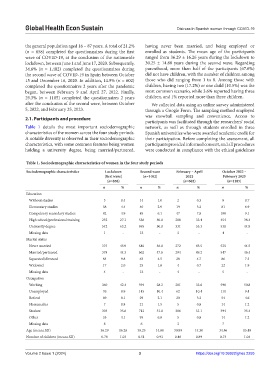
            the general population aged 16 – 87 years. A total of 21.2%   having  never  been  married,  and  being  employed  or
            (n = 858) completed the questionnaires during the first   enrolled as students. The mean age of the participants
            wave of COVID-19, at the conclusion of the nationwide   ranged from 36.29 ± 16.26 years during the lockdown to
            lockdown, between June 1 and June 17, 2020. Subsequently,   30.25 ± 14.88  years during the second wave. Regarding
            34.6% (n = 1,402) completed the questionnaires during   parenthood,  more  than  half  of  the  participants  (67.6%)
            the second wave of COVID-19 in Spain between October   did not have children, with the number of children among
            15 and December 16, 2020. In addition, 14.9% (n = 602)   those who did ranging from 1 to 8. Among those with
            completed the questionnaires 2 years after the pandemic   children, having two (17.2%) or one child (10.5%) was the
            began, between February 9 and April 27, 2022. Finally,   most common scenario, while 3.6% reported having three
            29.3% (n = 1185) completed the questionnaires 2  years   children, and 1% reported more than three children.
            after the conclusion of the second wave, between October   We collected data using an online survey administered
            5, 2022, and February 25, 2023.                    through a Google Form. The sampling method employed
                                                               was snowball sampling and convenience. Access to
            2.1. Participants and procedure
                                                               participants was facilitated through the researchers’ social
            Table 1 details the  most important  sociodemographic   network, as well as through students enrolled in three
            characteristics of the women across the four study periods.   Spanish universities who were awarded academic credit for
            A notable diversity is observed in their sociodemographic   their participation. Before completing the assessment, all
            characteristics, with some common features being women   participants provided informed consent, and all procedures
            holding  a  university  degree,  being  married/partnered,   were conducted in compliance with the ethical guidelines

            Table 1. Sociodemographic characteristics of women in the four study periods

            Sociodemographic characteristics  Lockdown       Second wave    February – April    October 2022 –
                                              (first wave)    (n=1402)          2022            February 2023
                                               (n=858)                         (n=602)            (n=1185)
                                             n       %       n      %       n        %         n         %
            Education
             Without studies                 3      0.4     14      1.0     2        0.3        8        0.7
             Elementary studies              38     4.4     40      2.9     19       3.2       81        6.9
             Compulsory secondary studies    42     4.9     85      6.1     47       7.8       108       9.1
             High school/professional training  232  27.1   556     40.0    200     33.4       454       38.4
             University degree              542     63.2    695     50.0    331     55.3       530       44.9
             Missing data                    1       -      12       -      3        -          4         -
            Marital status
             Never married                  375     43.9    640     46.0    272     45.5       525       44.5
             Married/partnered              378     44.3    662     47.6    294     49.2       547       46.4
             Separated/divorced              84     9.8     63      4.5     28       4.7       86        7.3
             Widowed                         17     2.0     25      1.8     4        0.7       22        1.9
             Missing data                    4       -      12       -      4        -          5         -
            Occupation
             Working                        360     42.4    394     28.2    201     33.6       598       50.8
             Unemployed                      76     8.9     145     10.4    62      10.4       111       9.4
             Retired                         69     8.1     29      2.1     20       3.3       54        4.6
             Homemaker                       7      0.8     21      1.5     5        0.8       14        1.2
             Student                        303     35.6    712     51.0    306     51.1       394       33.4
             Other                           35     4.1     95      6.8     5        0.8       14        1.2
             Missing data                    8               6              3                   7
            Age (mean±SD)                   36.29   16.26   30.25  14.88   30.99    14.30     34.86     15.48
            Number of children (mean±SD)    0.70    1.03    0.51    0.93   0.46     0.89       0.73      1.04


            Volume 2 Issue 1 (2024)                         3                        https://doi.org/10.36922/ghes.2255

