


Page 110 - GHES-2-1
P. 110
Global Health Econ Sustain                                      Distress in Spanish women through COVID-19


            Table 3. (Continued)
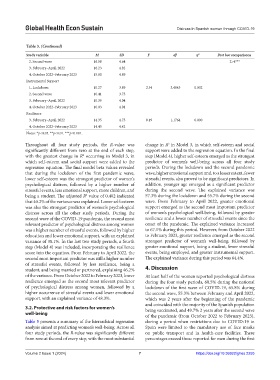
            Study variable                M         SD          F          df        η 2      Post hoc comparisons
             2. Second wave              16.58      4.64                                           2>4***
             3. February–April, 2022     16.23      4.82
             4. October 2022–February 2023  15.80   4.89
            Instrumental Support
             1. Lockdown                 10.27      3.89       2.34       3,4043    0.002
             2. Second wave              10.41      3.75
             3. February–April, 2022     10.39      4.04
             4. October 2022–February 2023  10.03   4.01
            Resilience
             3. February–April, 2022     14.35      4.75       0.19       1,1764    0.000
             4. October 2022–February 2023  14.45   4.42
            Notes: *p<0.05. **p<0.01. ***p<0.001.

            Throughout  all  four  study  periods,  the  R-value  was   change in R  in Model 3, in which self-esteem and social
                                                                         2
            significantly different from zero at the end of each step,   support were added to the regression equation. In the final
            with the greatest change in R  occurring in Model 3, in   step (Model 4), higher self-esteem emerged as the strongest
                                    2
            which self-esteem and social support were added to the   predictor of women’s well-being across all four study
            regression equation. The final model beta values revealed   periods. During the lockdown and the second pandemic
            that during the lockdown of the first pandemic wave,   wave, higher emotional support and, to a lesser extent, fewer
            lower self-esteem was the strongest predictor of women’s   stressful events, also proved to be significant predictors. In
            psychological distress, followed by a higher number of   addition, younger age emerged as a significant predictor
            stressful events, less emotional support, more children, and   during the second wave. The explained variance was
                                      2
            being a student. The adjusted R  value of 0.402 indicated   57.3% during the lockdown and 55.7% during the second
            that 40.2% of the variance was explained. Lower self-esteem   wave. From February to April 2022, greater emotional
            was also the strongest predictor of women’s psychological   support emerged as the second most important predictor
            distress  across  all  the  other study  periods. During  the   of women’s psychological well-being, followed by greater
            second wave of the COVID-19 pandemic, the second most   resilience and a lower number of stressful events since the
            relevant predictor of psychological distress among women   onset of the pandemic. The explained variance increased
            was a higher number of stressful events, followed by higher   to 67.1% during this period. However, from October 2022
            education and lower emotional support, with an explained   to February 2023, greater resilience emerged as the second
            variance of 38.1%. In the last two study periods, a fourth   strongest predictor of women’s well-being, followed by
            step (Model 4) was included, incorporating the resilience   greater emotional support, being a student, fewer stressful
            score into the equation. From February to April 2022, the   events, being employed, and greater instrumental support.
            second most important predictor was still a higher number   The explained variance during this period was 64.4%.
            of stressful events, followed by less resilience, being a
            student, and being married or partnered, explaining 46.2%   4. Discussion
            of the variance. From October 2022 to February 2023, lower   At least half of the women reported psychological distress
            resilience emerged as the second most relevant predictor   during the four study periods, 60.5% during the national
            of psychological distress among women, followed by a   lockdown of the first wave of COVID-19, 65.8% during
            higher occurrence of stressful events and lower emotional   the second wave, 55.3% between February and April 2022,
            support, with an explained variance of 48.3%.      which was 2  years after the beginning of the pandemic
                                                               and coincided with the majority of the Spanish population
            3.2. Protective and risk factors for women’s       being vaccinated, and 49.7% 2 years after the second wave
            well-being
                                                               of the pandemic (from October 2022 to February 2023),
            Table 5 presents a summary of the hierarchical regression   during a period when restrictions due to COVID-19 in
            analysis aimed at predicting women’s well-being. Across all   Spain were limited to the mandatory use of face masks
            four study periods, the R-value was significantly different   on public transport and in health-care facilities. These
            from zero at the end of every step, with the most substantial   percentages exceed those reported for men during the first


            Volume 2 Issue 1 (2024)                         7                        https://doi.org/10.36922/ghes.2255

