


Page 108 - GHES-2-1
P. 108
Global Health Econ Sustain                                      Distress in Spanish women through COVID-19


            included age and number of children as quantitative   of one or more family members and/or other loved ones,
            variables, education as an ordinal variable with five   reported by 29.9% of women, and illness of one’s own,
            degrees, and occupation and marital status as dummy   reported by 17.8% of women. A total of 22.9% of women
            variables. For occupation, two dummy variables were   who had partners reported having serious disagreements
            included: (i) student, coding all occupational categories   with their partners since the beginning of the pandemic.
            except students with 0 and students with 1 and (ii) working,   Excluding retirees and students, 16.6% of women reported
            coding employed women as 1 and all other occupational   job loss since the pandemic began. In addition, 7.5% of
            categories as 0. Marital status was coded as 1 for those   women reported experiencing other stressful events since
            married or with a partner and as 0 for other categories   the beginning of the pandemic. Although there was a
            (single, separated, divorced, and/or widowed). In Model 2   wide variety of events cited, the most frequently reported
            (second step), the score for the number of stressful events   were anxiety, depression, stress, insomnia, uncertainty,
            was added to the regression equation. Model 3 (third step)   increased workload, and  worsening  of physical and/or
            incorporated scores on self-esteem and emotional and   mental health for themselves or their family members.
            instrumental social support. In addition, resilience ratings   Table 3 shows the results of the ANOVAs in which the
            were included in Model 4 (fourth step) for the analyses   four study periods were considered independent variables.
            conducted between February and April 2022 and between   Statistically significant differences were observed in all
            October 2022 and February 2023. Analyses were calculated   variables except for psychological well-being, instrumental
            using IBM SPSS version 22.0.
                                                               support, and resilience. Post hoc analyses with Bonferroni
            3. Results                                         adjustment were performed to determine between which
                                                               groups statistically significant differences existed. These
            The analysis of the prevalence  of psychological distress   differences were found between the second wave with
            among women revealed that during the lockdown of the   respect to the lockdown and 2 years after the second wave
            first COVID-19 wave, it was 60.5%; during the second   (between October 2022 and February 2023). Specifically,
            wave, it rose to 65.8%; between February and April 2022, it   during  the  second  wave  of  the  pandemic,  women
            decreased to 55.3%; and between October 2022 and February   experienced higher  levels of psychological distress, more
            2023, it further decreased to 49.7%. These differences were   negative feelings, lower self-esteem, and greater emotional
            statistically significant (χ  [3, N = 4033] = 72.82, p < 0.001).  support  than  during  the  lockdown  and  2  years  after  the
                                2
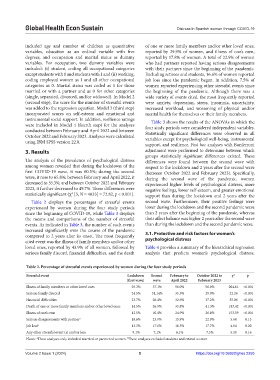
              Table 2 displays the percentages of stressful events   second wave. Furthermore, their positive feelings were
            experienced by women during the four study periods   lower during the lockdown and the second pandemic wave
            since the beginning of COVID-19, while Table 3 displays   than 2 years after the beginning of the pandemic, whereas
            the  means  and comparisons of  the  number  of  stressful   their affect balance was higher 2 years after the second wave
            events. As indicated in Table 3, the number of such events   than during the lockdown and the second pandemic wave.
            increased significantly over the course of the pandemic
            compared to 2 years after its onset. The most frequently   3.1. Protective and risk factors for women’s
            cited event was the illness of family members and/or other   psychological distress
            loved ones, reported by 43.9% of all women, followed by   Table 4 provides a summary of the hierarchical regression
            serious family discord, financial difficulties, and the death   analysis that predicts women’s psychological distress.


            Table 2. Percentage of stressful events experienced by women during the four study periods
            Stressful event                            Lockdown    Second   February to    October 2022 to    χ 2  p
                                                       (first wave)  wave  April 2022  February 2023
            Illness of family members or other loved ones  29.3%  37.1%     56.0%       56.0%     204.61  <0.001
            Serious family discord                       24.5%    31.14%    35.3%       29.0%      22.26  <0.001
            Financial difficulties                       23.7%    26.4%     32.6%       37.2%      55.06  <0.001
            Death of one or more family members and/or other loved ones  14.5%  26.9%  35.8%  41.3%  183.42  <0.001
            Illness of one’s own                         12.5%    10.4%     24.9%       26.8%     153.59  <0.001
            Serious disagreements with partner a         18.6%    23.9%     15.9%       22.9%      5.68  0.13
            Job loss b                                   13.3%    17.6%     16.5%       17.7%      4.64  0.20
            Any other stressful event (s) and/or loss    9.1%     7.1%      6.1%         7.5%      5.10  0.16
            Notes:  These analyses only included married or partnered women.  These analyses excluded students and retired women.
                 a
                                                       b
            Volume 2 Issue 1 (2024)                         5                        https://doi.org/10.36922/ghes.2255

