


Page 141 - GHES-2-1
P. 141
Global Health Econ Sustain                                                   Elderly people with dementia


            Table 5. Backgrounds of patients with dementia (PWD)
            Backgrounds of PWD  Hong Kong      Japan     Singapore (SG,   ANOVA        Post hoc comparison between
                               (HK, N=164)   (JP, N=166)    N=233)                            regions a
                              n  Mean  SD  n   Mean  SD  n  Mean  SD   F   Df    p     HK    HK versus  JP versus
                                                                                      versus JP  SG     SG
            Age              153  84.5  7.33 157  82.1  7.54 233  81.5  6.96  8.311  2  0.000***  0.009** b  0.000*** b  0.730 b
            Number of years being   139  4.8  3.22 141  3.4  3.64 233  1.6  2.33 51.453  2  0.000***  0.001**  0.000***  0.000***
            diagnosed with dementia
            Number of medication   150  5.6  3.72 132  3.5  3.06 230  6.4  2.79 35.732  2  0.000***  0.000***  0.045*  0.000***
            (s) taken
            Notes: *p<0.05; **p<0.01; ***p<0.001.  Games-Howell test, which the assumption of homogeneity of variance was violated.  Tukey HSD test.
                                    a
                                                                                          b
            Abbreviations: df: Degree of freedom; SD: Standard deviation.
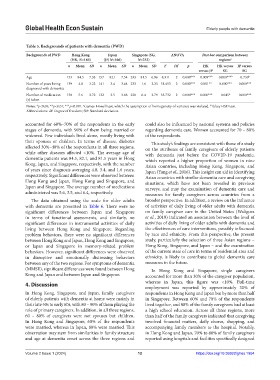
            accounted for 60%–70% of the respondents in the early   could also be influenced by national systems and policies
            stages of dementia, with 90% of them being married or   regarding dementia care. Women accounted for 70 – 80%
            widowed. Few individuals lived alone, mostly living with   of the respondents.
            their spouses or children. In terms of disease, diabetes   This study’s findings are consistent with those of a study
            affected 30%–40% of the respondents in all three regions,   on the attributes of family caregivers of elderly patients
            while other diseases affected <10%. The average age of   with  dementia just  before  the COVID-19  pandemic,
            dementia patients was 84.5, 82.1, and 81.5 years in Hong   which reported a higher proportion of women in nine
            Kong, Japan, and Singapore, respectively, with the number   Asian countries, including Hong Kong, Singapore, and
            of years since diagnosis averaging 4.8, 3.4, and 1.6 years,   Japan (Yang et al., 2016). This insight can aid in identifying
            respectively. Significant differences were observed between   Asian countries with similar dementia care and caregiving
            Hong Kong and Japan, Hong Kong and Singapore, and   situations, which have not been revealed in previous
            Japan and Singapore. The average number of medications   surveys, and may the examination of dementia care and
            administered was 5.6, 3.5, and 6.4, respectively.  measures for family caregivers across countries from a
              The data obtained using the scale for older adults   broader perspective. In addition, a review on the influence
            with dementia are presented in  Table  6. There were no   of activities of daily living of older adults with dementia
            significant differences between Japan and Singapore   on family caregiver care in the United States (Waligora
            in terms of functional assessments, and similarly, no   et al., 2019) indicated an association between the level of
            significant differences in instrumental activities of daily   activities of daily living of older adults with dementia and
            living between Hong Kong and Singapore. Regarding   the effectiveness of care interventions, possibly influenced
            problem behaviors, there were no significant differences   by race and ethnicity. From this perspective, the present
            between Hong Kong and Japan, Hong Kong and Singapore,   study, particularly the selection of three Asian regions –
            or Japan and Singapore in memory-related problem   Hong Kong, Singapore, and Japan – and the examination
            behaviors. However, significant differences were observed   of the current state of care in terms of residential area and
            in disruptive and emotionally distressing behaviors   ethnicity, is likely to contribute to global dementia care
            between any of the two regions. For symptoms of dementia   measures in the future.
            (MMSE), significant differences were found between Hong   In Hong Kong and Singapore, single caregivers
            Kong and Japan and between Japan and Singapore.    accounted for more than 30% of the caregiver population,

            4. Discussion                                      whereas in Japan, this figure was <10%. Full-time
                                                               employment was reported by approximately 30% of
            In Hong Kong, Singapore, and Japan, family caregivers   respondents in Hong Kong and Japan but by more than half
            of elderly patients with dementia at home were mainly in   in Singapore. Between 60% and 70% of the respondents
            their late 50s to early 60s, with 80 – 90% of them playing the   lived together, and 80% of the family caregivers had at least
            role of primary caregivers. In addition, in all three regions,   a high school education. Across all three regions, more
            60 – 80% of caregivers were not spouses but children.   than half of the family caregivers indicated that caregiving
            In Hong Kong and Singapore, 60% of the respondents   involved  financial  matters, daily chores,  shopping, and
            were married, whereas in Japan, 80% were married. This   accompanying family members to the hospital. Notably,
            observation may stem from similarities in family structure   in Hong Kong and Japan, 70% to 80% of family caregivers
            and age at dementia onset across the three regions and   reported using hospitals and facilities specifically designed


            Volume 2 Issue 1 (2024)                         12                       https://doi.org/10.36922/ghes.1954

