


Page 137 - GHES-2-1
P. 137
Global Health Econ Sustain                                                   Elderly people with dementia


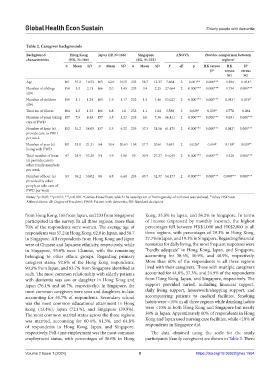
            Table 2. Caregiver backgrounds
            Background         Hong Kong   Japan (JP, N=166)   Singapore    ANOVA       Post hoc comparison between
            characteristics   (HK, N=164)                  (SG, N=233)                         regions a
                             n  Mean  SD   n  Mean  SD   n   Mean  SD    F   df    p    HK versus   HK   JP
                                                                                          JP     versus   versus
                                                                                                  SG     SG
            Age             161  57.2  10.52 165  62.0  10.51 233  58.7  12.37  7.664  2  0.001**  0.000***  0.384  0.014*
            Number of siblings   158  3.3  2.11  166  2.0  1.45  233  3.4  2.25  27.664  2  0.000***  0.000***  0.734  0.000***
            alive
            Number of children   159  1.1  1.24  165  1.9  1.17  233  1.5  1.46  13.027  2  0.000***  0.000***  0.013*  0.019*
            alive
            Total no. of illness  164  1.2  1.32  166  0.8  1.0  233  1.1  1.04  3.588  2  0.028*  0.039*  0.778  0.064
            Number of years taking  157  7.9  8.45  157  3.5  3.23  233  6.0  7.36  16.411  2  0.000***  0.000***  0.051  0.000***
            care of PWD
            Number of hour (s)   152  51.2  54.09 137  5.3  6.32  233  37.3  31.56 61.175  2  0.000***  0.000***  0.012*  0.000***
            provide care to PWD
            per week
            Number of year (s)   101  33.0  21.31  84  30.4  20.65 158  37.7  20.61  3.683  2  0.026*  0.684 b  0.185 b  0.029* b
            living with PWD
            Total number of hour   67  38.9  53.26  54  4.9  4.06  59  30.9  27.27 14.045  2  0.000***  0.000***  0.528  0.000***
            (s) provide care to
            other family members
            per week
            Number of hour (s)   83  76.2  50.02  88  4.8  6.60  233  49.7  52.37 54.177  2  0.000***  0.000***  0.000*** 0.000***
            provided by other
            people to take care of
            PWD per week
            Notes: *p<0.05; **p<0.01; ***p<0.001.  Games-Howell test, which the assumption of homogeneity of variance was violated.  Tukey HSD test.
                                                                                          b
                                    a
            Abbreviations: df: Degree of freedom; PWD: Patient with dementia; SD: Standard deviation.
            from Hong Kong, 166 from Japan, and 233 from Singapore)   Kong, 35.5% in Japan, and 56.2% in Singapore. In terms
            participated in the survey. In all three regions, more than   of income (expressed by monthly income), the highest
            70% of the respondents were women. The average age of   percentages fell between HK$1,000 and HK$2,000 in all
            respondents was 57.2 in Hong Kong, 62.0 in Japan, and 58.7   three regions, with percentages of 29.3% in Hong Kong,
            in Singapore. All respondents from Hong Kong and Japan   27.7% in Japan, and 19.3% in Singapore. Regarding financial
            were of Chinese and Japanese ethnicity, respectively, while   resources for daily living, the most frequent responses were
            in Singapore, 93.6% were Chinese, with the remaining   “hardly adequate” in Hong Kong, Japan, and Singapore,
            belonging to  other  ethnic  groups. Regarding primary   accounting for 38.5%, 50.9%, and 48.9%, respectively.
            caregiver status, 92.6% of the Hong Kong respondents,   More than 60% of the respondents in all three regions
            90.3% from Japan, and 83.7% from Singapore identified as   lived with their caregivers. Those with multiple caregivers
            such. The most common relationship with elderly patients   accounted for 44.8%, 37.3%, and 24.9% of the respondents
            with dementia was son or daughter in Hong Kong and   from Hong Kong, Japan, and Singapore, respectively. The
            Japan (76.1% and 46.7%, respectively). In Singapore, the   support  provided  varied,  including  financial  support,
            most common caregivers were sons and daughters-in-law,   daily living support, housework/shopping support, and
            accounting for 65.7% of respondents. Secondary school   accompanying patients to medical facilities. Smoking
            was the most common educational attainment in Hong   habits were <10% in all three regions while drinking habits
            Kong (43.4%), Japan (72.1%), and Singapore (39.9%).   were <10% in both Hong Kong and Singapore but nearly
            The most common marital status across the three regions   30% in Japan. Approximately 60% of respondents in Hong
            was married, accounting for 60.4%, 81.3%, and 64.8%   Kong and Japan used nursing care facilities, while <10% of
            of respondents in Hong Kong, Japan, and Singapore,   respondents in Singapore did.
            respectively. Full-time employment was the most common   The data obtained using the scale for the study
            employment status, with percentages of 36.6% in Hong   participants (family caregivers) are shown in Table 3. There


            Volume 2 Issue 1 (2024)                         8                        https://doi.org/10.36922/ghes.1954

