


Page 142 - GHES-2-1
P. 142
Global Health Econ Sustain                                                   Elderly people with dementia


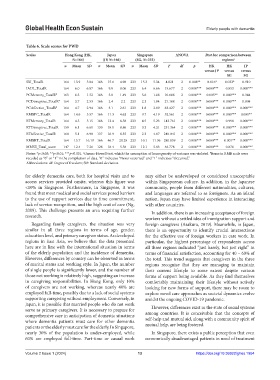
            Table 6. Scale scores for PWD
            Scales           Hong Kong (HK,    Japan       Singapore        ANOVA       Post hoc comparison between
                                N=164)       (JP, N=166)   (SG, N=233)                         regions a
                            n   Mean  SD   n  Mean  SD   n  Mean  SD     F    df   p      HK     HK      JP
                                                                                        versus JP  versus   versus
                                                                                                  SG     SG
            SBI_TotalR      164  13.9  5.84  166  15.6  4.98  233  15.3  5.34  4.821  2  0.008**  0.016*  0.032*  0.910
            IADL_TotalR     164  6.0  6.87  166  9.9  8.06  233  6.4  6.66  15.677  2  0.000***  0.000***  0.853  0.000***
            PCMemory_TotalR #  163  6.3  1.32  166  5.8  1.49  233  5.6  1.68  10.608  2  0.000***  0.005**  0.000***  0.344
            PCDisruptive_TotalR #  164  3.7  2.53  166  2.4  2.2  233  2.3  1.94  21.108  2  0.000***  0.000***  0.000***  0.804
            PCAffective_TotalR #  164  4.7  2.94  166  3.1  2.61  233  1.8  2.09  63.427  2  0.000***  0.000***  0.000***  0.000***
            RMBPC_TotalR    164  14.6  5.57  166  11.3  4.63  233  9.7  4.19  52.561  2  0.000***  0.000***  0.000***  0.001**
            RTMemory_TotalR  164  4.5  5.15  166  13.4  6.58  233  4.5  5.23  143.761  2  0.000***  0.000***  0.998  0.000***
            RTDisruptive_TotalR  159  6.1  6.61  130  18.1  8.86  233  3.3  4.31  231.364  2  0.000***  0.000***  0.000***  0.000***
            RTAffective_TotalR  160  5.1  6.98  137  16.9  8.35  233  2.3  4.07  240.041  2  0.000***  0.000***  0.000***  0.000***
            RMBRT_TotalR    164  15.7  16.19 166  46.7  20.28 233  10.1  11.36 280.859  2  0.000***  0.000***  0.001**  0.000***
            MMSE_Total_score  147  12.4  7.26  128  18.4  5.58  233  12.1  5.83  46.778  2  0.000***  0.000***  0.876  0.000***
                                                                                          #
                                    a
            Notes: *p<0.05; **p<0.01; ***p<0.001.  Games-Howell test, which the assumption of homogeneity of variance was violated.  Items in RMB scale were
            recoded as “0” or “1” in the compilation of data. “0” indicates “Never occurred” and “1” indicates “Occurred.”
            Abbreviations: df: Degree of freedom; SD: Standard deviation.
            for elderly dementia care, both for hospital visits and to   may either be undeveloped or considered unacceptable
            access services provided onsite, whereas this figure was   within Singaporean culture. In addition, in the Japanese
            <10% in Singapore. Furthermore, in Singapore, it was   community, people from different nationalities, cultures,
            found that most medical and social services posed barriers   and languages are referred to as foreigners. As an island
            to the use of support services due to time commitment,   nation, Japan may have limited experience in interacting
            lack of service recognition, and the high cost of care (Ng,   with other countries.
            2009). This challenge presents an area requiring further   In addition, there is an increasing acceptance of foreign
            research.
                                                               workers without a settled idea of immigration support and
              Regarding family caregivers, the situation was very   foreign caregivers (Asakura, 2019). Meanwhile, in Japan,
            similar in all three regions in terms of age, gender,   there  is  an  opportunity  to  identify  crucial  intersections
            education level, and primary caregiver status. As developed   for the effective use of foreign workers in care work. In
            regions in East Asia, we believe that the data presented   particular, the highest percentage of respondents across
            here are in line with the international situation in terms   all three regions indicated “just barely, but just right” in
            of the elderly population and the incidence of dementia.   terms of financial satisfaction, accounting for 40 – 60% of
            However, differences by country can be observed in terms   the total. This trend suggests that caregivers in the three
            of marital status and working style. In Japan, the number   regions recognize that they are managing to maintain
            of single people is significantly lower, and the number of   their current lifestyle to some extent despite various
            those not working is relatively high, suggesting an increase   forms of support being available. As they find themselves
            in caregiving responsibilities. In Hong Kong, only 10%   comfortably maintaining their lifestyle without actively
            of caregivers are not working, whereas nearly 40% are   looking for new forms of support, there may be room to
            employed full-time, possibly due to a lack of social systems   explore novel care approaches as societal dynamics evolve
            supporting caregiving without employment. Conversely, in   amidst the ongoing COVID-19 pandemic.
            Japan, it is possible that married people who do not work
            serve as primary caregivers. It is necessary to prepare for   However, differences exist in the state of social systems
            comprehensive care in anticipation of domestic situations   among countries. It is conceivable that the concepts of
            where  dementia  patients  must  care  for  other  dementia   self-help and mutual aid, along with a community spirit of
            patients or the elderly must care for the elderly. In Singapore,   mutual help, are being fostered.
            nearly  30%  of  the  population  is  under-employed,  while   In Singapore, there exists a public perception that even
            60% are employed full-time. Part-time or casual work   economically disadvantaged patients in need of treatment


            Volume 2 Issue 1 (2024)                         13                       https://doi.org/10.36922/ghes.1954

