


Page 165 - GHES-2-1
P. 165
Global Health Econ Sustain                                              Total sugar consumption Philippines


                                                               Philippines  were  overweight  and obese  (WHO  Western
                      1.2*  −2.2*  2.3*  −0.1  0.6  1.4*  −20.8*  −58.0*  2.5*  −7.0*  0.7*  Pacific Region, 2017). In 2019, the Department of Health
                                                               and the Philippine Society of Endocrinology, Diabetes, and
                                                               Metabolism expressed concerns that the number of diabetic
                    9 – 18 years old  7.2 (0.3)  6.5 (0.2)  5.0 (0.2)  9.8 (0.5)  1.8 (0.4)  1.9 (0.2)  54.1 (1.4)  276.1 (2.7)  4.6 (0.3)  93.7 (1.4)  2.7 (0.2)  Filipinos has reached seven million, indicating that diabetes
                                                               has reached epidemic proportion (ABS-CBN News, 2019).
                                                               Notably, a newspaper article reported that in 2020 during
                      6.0 (0.4)  8.7 (0.3)  2.7 (0.2)  9.9 (0.7)  1.1 (0.2)  0.5 (0.1)  74.9 (2.4)  334.1 (3.5)  2.0 (0.2)  100.7 (2.3)  2.1 (0.2)  the pandemic, Filipino online searches for chocolates and
                                                               confectionery increased by 91% as compared to the online
                                                               searches in 2019 (Villanueva, 2021).

                      −0.4  −1.2*  1.7*  1.7*  0.2  1.0*  −9.2*  −37.0*  5.3*  −1.1  0.3  4.1. Limitations of the study
                                                               A limitation of the present study was the use of the national
                    3 – 8 years old
                                                               food consumption data from 2008 to estimate the levels and
                                               150.9 (2.2)
                                            30.1 (1.0)
                                                    59.3 (1.2)
                                                 13.2 (0.7)
                         4.7 (0.2)
                                                       1.5 (0.2)
                      6.0 (0.4)
                            3.5 (0.2)
                                      1.6 (0.2)
                                   1.4 (0.3)
                                 6.6 (0.4)
                                                               sources of sugar intake. However, changes in the consumption
                 Mean intake (standard error [SE]) (g/day)  6.4 (0.4)  0.2  5.9 (0.3)  −0.7*  1.8 (0.2)  0.9*  4.9 (0.5)  0.8  1.2 (0.2)  −0.6  0.6 (0.2)  1.3  39.3 (2.0)  −2.4  187.9 (2.8)  −27.1*  7.9 (0.8)  6.8*  60.4 (1.7)  1.1  1.2 (0.1)  −0.3  proxy measurement and trend of recent sugar consumption.
                                                               of sugar were evaluated between 2008 and 2013 to provide a
                                                               Despite this limitation, this study was the only in-depth
                                                               assessment of sugar intake among Filipino children and
                                                               adolescents using nationally representative data.
                                                                 Another limitation was the fact that only total sugars
                                                               (rather  than  natural  vs.  added  sugar)  could  be  analyzed
                                                               using food composition tables. It is also known that dietary
                    1 – 2 years old
                                                               assessment methods are  imprecise  due  to measurement
                                                               establish  the  level  of  sugar  intake.  Recently,  the  δ C
                                                                                                           13
                                                               biomarker, extracted from fingerstick blood samples, was
                      3.8 (0.4)  4.0 (0.4)  2.1 (0.1)  2.8 (0.2)  2.0 (0.2)  1.1 (0.2)  4.0 (0.4)  3.2 (0.5)  1.2 (0.4)  1.8 (0.5)  1.6 (0.6)  0.3 (0.2)  16.0 (1.1)  18.4 (1.4)  83.5 (3.5)  110.6 (4.5)  25.2 (1.7)  18.4 (1.5)  26.9 (1.2)  25.8 (1.5)  0.5 (0.1)  0.8 (0.2)  errors, and biochemical methods are needed to definitively
                                                               reported to be a valid and sensitive biomarker of added
                                                               sugar and sugar-sweetened beverage intake in children and
                                                               adolescents (MacDougall et al., 2018).
                      −2.1*  −0.3  0.5*  0.6  −0.8  -  2.1  −32.6*  2.6  −0.6  0.3  5. Conclusion
                    7 – 11 months old  0.3 (0.1)  0.4 (0.1)  0.7 (0.2)  1.0 (0.3)  0.4 (0.4)  0  4.2 (1.2)  52.7 (11.3)  12.9 (2.7)  4.2 (0.9)  0.4 (0.3)  The present study reported that in 2008, the median intake
                                                               of total sugar among Filipino children aged 7 months to
                                                               18 years old ranged from 19 to 29.9 g/day. Among children
                                                               in the highest wealth quintiles, consumption exceeded
                      2.4 (0.9)  0.7 (0.3)  0.2 (0.1)  0.3 (0.2)  1.2 (0.7)  0  2.1 (0.6)  85.3 (12.2)  10.3 (2.6)  4.8 (0.9)  0.1 (0.01)  25 g/day. Total sugar comprised 5.3 – 30.9% of total energy
                                                               intake. Minimally processed foods contributed 31 – 36%
                                                               of total sugar, while processed foods contributed 64 – 75%
                                                               of total sugar, suggesting that added (rather than naturally
                                                               occurring) sugar is the predominant form of dietary sugar
                                                               in this group. The highest contributors were milk formula
                                                               and milk products (for children aged 7 – 11  months

                                                               confectionery (for children aged 7 – 11 months old and 1 –
             Table 6: (Continued)  Characteristics  Age group  (vii) Instant noodles (viii) Fats, oils, and related product  (ix)   Processed soup, sauces,   and flavor enhancers  (x) Other noodles and pasta (xi) Beans, nuts, and seed products  (xii) Vegetable and fruit products  Minimally processed foods  (i) Vegetables and fruits  (ii) Rice, cereals, and starches  (iii) Milk  (iv) Fish, meat, and poultry  (v) Beans, nuts, and seeds *p-value < 0.05. Abbreviation: SE: Sta
                                                               18 years old); and non-alcoholic beverages (for children
                                                               aged 1 – 18 years old). Likewise, the sweetened foods with
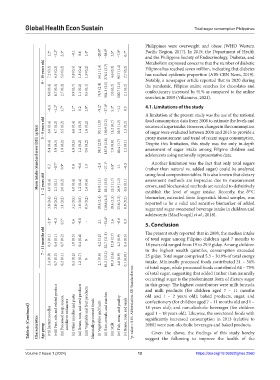
                                                               significantly increased consumption in 2013 (relative to
                                                               2008) were non-alcoholic beverages and baked products.
                                                                 Given  the  above,  the  findings  of  this study  hereby


            Volume 2 Issue 1 (2024)                         12   suggest the following to improve the health of the
                                                                                     https://doi.org/10.36922/ghes.2060

