


Page 182 - GHES-2-1
P. 182
Global Health Econ Sustain                                               Income-related inequality in health


            Researchers can freely download the datasets from the   indicating having ADL limitations and zero indicating no
            following  website:  https://www.icpsr.umich.edu/web/  ADL limitations. These two measurements were validated
            NACDA/studies/36179. This survey marks the first national   in previous studies (Yang & Kanavos, 2012; Pan et al., 2019;
            effort to examine the determinants of health among older   Sun et al., 2020).
            individuals in China using internationally compatible
            questionnaires. To obtain a nationally representative   2.2.2. Independent variables of interest: Income
            sample, this survey randomly selected older Chinese   Income was analyzed as a continuous variable based
            individuals aged 65 and above from approximately half of   on the question, “What was the income per capita of
            all the counties and cities across 22 provinces, constituting   your household last year ?” As this study examined the
            approximately 85% of the total population in China (Zeng,   individual level of inequalities in health, household size
            2004). This wave was selected as it represents the most   and demographic composition were considered to adjust
            recent health status of elderly individuals in China. After   for household income. The equivalence scale is a tool
            excluding cases with missing values for SRH, functional   used in many studies to transform household income into
            ability, income, and other demographic and socioeconomic   equivalent individual  income  (Yang  & Kanavos,  2012;
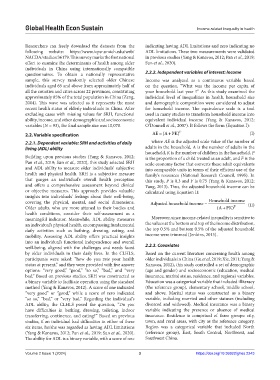
            variables (N = 93), the final sample size was 10,078.  O’Donnell et al., 2007). It follows the form (Equation I):

            2.2. Variable specification                           AE = ( APK+  ) F                         (I)
            2.2.1. Dependent variable: SRH and activities of daily   where AE is the adjusted scale value of the number of
            living (ADL) ability                               adults in the household, A is the number of adults in the
                                                               household, K is the number of children in the household, P
            Building  upon  previous  studies  (Yang  &  Kanavos,  2012;   is the proportion of a child treated as an adult, and F is the
            Pan et al., 2019; Sun et al., 2020), this study selected SRH   scale economy factor that converts these adult equivalents
            and ADL ability to measure older individuals’ subjective   into comparable units in terms of their efficient use of the
            health and physical  health.  SRH is  a  subjective  measure   family’s resources (National Research Council, 1995). In
            that gauges an individual’s overall health perception   this study, P is 0.3 and F is 0.75 (Yang & Kanavos, 2012;
            and offers a comprehensive assessment beyond clinical   Yang, 2013). Thus, the adjusted household income can be
            or  objective  measures.  This  approach provides valuable   calculated using Equation II:
            insights into individuals’ feelings about their well-being,
            covering the physical, mental, and social dimensions.   Adjusted household income  =  Household income  (II)
            Older adults, who are more attuned to their bodies and                           (A + PK) F
            health conditions, consider their self-assessment as a
            meaningful indicator. Meanwhile, ADL ability measures   Moreover, since income-related inequality is sensitive to
            an individual’s physical health, encompassing fundamental   the values at the bottom and top of the income distribution,
            daily activities such as bathing, dressing, eating, and   the top 0.5% and bottom 0.5% of the adjusted household
            mobility. Assessing ADL ability offers practical insights   income were trimmed (Jenkins, 2015).
            into an individual’s functional independence and overall
            well-being,  aligned  with  the  challenges  and  needs  faced   2.2.3. Covariates
            by older individuals  in their daily lives. In  the CLHLS,   Based on the current literature concerning health among
            participants were asked: “how do you rate your health   older individuals in China (Gu et al, 2019; Xie, 2011; Yang &
            status at present,” and they were provided with five answer   Kanavos, 2012), this study controlled a set of demographic
            options: “very good,” “good,” “so so,” “bad,” and “very   (age and gender) and socioeconomic (education, medical
            bad.” Based on previous studies, SRH was constructed as   insurance, marital status, residence, and regions) variables.
            a binary variable to facilitate operation using the standard   Education was a categorical variable that included illiteracy
            method (Yang & Kanavos, 2012). A score of one indicated   (the reference group), elementary school, middle school,
            “very good” or “good,” while a score of zero indicated   and above. Marital status was constructed as a binary
            “so so,” “bad,” or “very bad.” Regarding the individual’s   variable, including married and other statuses (including
            ADL ability, the CLHLS posed the question, “Do you   divorced and widowed). Medical insurance was a binary
            have difficulties in bathing, dressing, toileting, indoor   variable  indicating  the  presence  or  absence  of  medical
            transferring, continence, and eating?” Based on previous   insurance. Residence is comprised of three groups: city,
            studies, if an individual had difficulties in either of these   town, and rural areas, with city as the reference category.
            six items, he/she was regarded as having ADL limitations   Region  was  a  categorical  variable  that  included  North
            (Yang & Kanavos, 2012; Pan et al., 2019; Sun et al., 2020).   (reference group), East, South Central, Northwest, and
            The ability for ADL is a binary variable, with a score of one   Southwest China.


            Volume 2 Issue 1 (2024)                         3                        https://doi.org/10.36922/ghes.2243

