


Page 186 - GHES-2-1
P. 186
Global Health Econ Sustain                                               Income-related inequality in health


                                                               suggesting that pro-rich inequality in good SRH is mainly
                                                               driven by socioeconomic factors. For ADL ability, 100.95%
                                                               of the total inequality disadvantaging the poor with regard
                                                               to ADL limitations is driven by income. The contribution
                                                               of demographic factors to total inequality is much higher,
                                                               reaching around 30%, compared to inequality in SRH. The
                                                               contributions of education, residence, and regional factors
                                                               to total inequality are 28.76%, −35.71%, and −37.33%,
                                                               respectively. In conclusion, a large share of the inequality in
                                                               health among older individuals is related to socioeconomic
                                                               factors.
                                                                 Tables S1, S2, and S3 present  the  results  of  the
                                                               robustness checks that are similar to the main results.
                                                               Table S1 demonstrates that for SRH, the unstandardized
                                                               EI is 0.014, and the standardized EI is 0.013, suggesting
                                                               that the rich are more likely to have good SRH, even after
                                                               controlling for demographic factors. For ADL ability,
                                                               the unstandardized  EI is −0.066 and the standardized
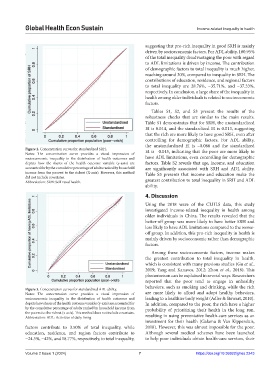
            Figure 2. Concentration curves for standardized SRH.  EI is −0.045, indicating that the poor are more likely to
            Notes:  The concentration  curve  provides  a  visual  impression  of
            socioeconomic inequality in the distribution of health outcomes and   have ADL limitations, even controlling for demographic
            depicts how the shares of the health outcome variable (y-axis) are   factors. Table S2 reveals that age, income, and education
            accounted for by the cumulative percentage of adults ranked by household   are significantly associated with SRH and ADL ability.
            income from the poorest to the richest (X-axis). However, this method   Table  S3  presents  that  income and  education  make the
            did not include covariates.
            Abbreviation: SRH: Self-rated health.              greatest contribution to total inequality in SRH and ADL
                                                               ability.
                                                               4. Discussion

                                                               Using  the 2018 wave  of the  CLHLS data,  this study
                                                               investigated income-related inequality in health among
                                                               older individuals in China. The results revealed that the
                                                               better-off group was more likely to have better SRH and
                                                               less likely to have ADL limitations compared to the worse-
                                                               off group. In addition, this pro-rich inequality in health is
                                                               mainly driven by socioeconomic rather than demographic
                                                               factors.
                                                                 Among  these  socioeconomic  factors,  income  makes
                                                               the greatest contribution to total inequality in health,
                                                               which is consistent with many previous studies (Gu et al.,
                                                               2019; Yang and Kanavos, 2012; Zhou  et al., 2018). This
                                                               phenomenon can be explained in several ways. Researchers
                                                               reported that the poor tend to engage in unhealthy
                                                               behaviors, such as smoking and drinking, while the rich
            Figure 3. Concentration curves for standardized ADL ability.
            Notes: The  concentration curve  provides a  visual impression  of   are more likely to afford and adopt healthy behaviors,
            socioeconomic inequality in the distribution of health outcomes and   leading to a healthier body weight (Adler & Stewart, 2010).
            depicts how shares of the health outcome variable (y-axis) are accounted for   In addition, compared to the poor, the rich have a higher
            by the cumulative percentage of adults ranked by household income from   probability of prioritizing their health in the long run,
            the poorest to the richest (x-axis). This method does not include covariates.
            Abbreviation: ADL: Activities of daily living.     resulting in using preventative health-care services as an
                                                               investment for their health (Galama & Van Kippersluis,
            factors contribute to 3.50% of total inequality, while   2018). However, this was almost impossible for the poor.
            education, residence, and region factors contribute to   Although several medical schemes have been launched
            −24.5%, −42%, and 18.77%, respectively, to total inequality,   to help poor individuals obtain health-care services, their


            Volume 2 Issue 1 (2024)                         7                        https://doi.org/10.36922/ghes.2243

