


Page 185 - GHES-2-1
P. 185
Global Health Econ Sustain                                               Income-related inequality in health


                                                               Table 2. Erreygers concentration index (EI) for SRH and
                                                               ADL ability
                                                               Concentration Index  SRH     Having ADL limitations
                                                               Unstandardized EI   0.068          −0.016
                                                               Standardized EI     0.033          −0.003
                                                               Notes: The concentration index method did not include covariates.
                                                               Abbreviations: ADL: Activities of daily living; SRH: Self-rated health.

                                                               Table 3. Determinants of SRH and ADL ability
                                                               Variables                 SRH       ADL ability
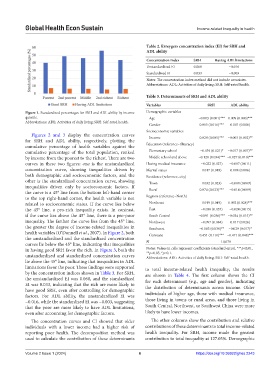
            Figure 1. Standardized percentages for SRH and ADL ability by income   Demographic variables
            quintile.                                           Age                  −0.003 (0.001)*** 0.009 (0.000)***
            Abbreviations: ADL: Activities of daily living; SRH: Self-rated health.
                                                                Gender                0.065 (0.016)***  0.001 (0.006)
                                                               Socioeconomic variables
              Figures  2  and  3  display  the  concentration  curves
            for SRH and ADL ability, respectively, plotting the   Income              0.028 (0.005)***  −0.005 (0.002)**
            cumulative percentage of health variables against the   Education (reference=illiteracy)
            cumulative percentage of the total population, ranked   Elementary school  −0.039 (0.021)*  −0.017 (0.007)**
            by income from the poorest to the richest. There are two   Middle school and above  −0.128 (0.034)*** −0.027 (0.010)***
            curves in these two figures: one is the unstandardized   Having medical insurance  −0.022 (0.027)  −0.007 (0.011)
            concentration curve, showing inequalities driven by   Marital status       0.017 (0.018)  0.008 (0.006)
            both demographic and socioeconomic factors, and the   Residence (reference=city)
            other is the standardized concentration curve, showing   Town              0.032 (0.023)  −0.008 (0.009)
            inequalities driven only by socioeconomic factors. If
            the curve is a 45° line from the bottom left-hand corner   Rural          0.074 (0.023)***  −0.014 (0.009)
            to the top right-hand corner, the health variable is not   Regions (reference=North)
            related to socioeconomic status. If the curve lies below   Northeast       0.019 (0.049)  0.092 (0.028)***
            the 45° line, a pro-rich inequality exists. In contrast,   East           −0.036 (0.035)  −0.024 (0.015)
            if the curve lies above the 45° line, there is a pro-poor   South Central  −0.091 (0.036)*** −0.034 (0.015)**
            inequality. The farther the curve lies from the 45° line,   Northwest     −0.097 (0.084)  0.017 (0.026)
            the greater the degree of income-related inequalities in   Southwest      −0.083 (0.039)**  −0.029 (0.017)*
            health variables (O’Donnell et al., 2007). In Figure 2, both   Constant   0.451 (0.110)*** −0.471 (0.048)***
            the unstandardized and the standardized concentration
            curves lie below the 45° line, indicating that inequalities   N                    10,078
            in having good SRH favor the rich. In Figure 3, both the   Notes: Values in cells represent coefficients (standard error). ***p<0.01,
                                                               **p<0.05, *p<0.1.
            unstandardized and standardized concentration curves   Abbreviations: ADL: Activities of daily living; SRH: Self-rated health.
            lie above the 45° line, indicating that inequalities in ADL
            limitations favor the poor. These findings were supported   to total income-related health inequality; the results
            by the concentration indices shown in Table 3. For SRH,   are shown in  Table  4. The first column shows the CI
            the unstandardized EI was 0.068, and the standardized   for each determinant (e.g., age and gender), indicating
            EI was 0.033, indicating that the rich are more likely to   the distribution of determinants across income. Older
            have good SRH, even after controlling for demographic
            factors. For ADL ability, the unstandardized EI was   individuals of higher age, those with medical insurance,
            −0.016, while the standardized EI was −0.003, suggesting   those living in towns or rural areas, and those living in
            that the poor are more likely to have ADL limitations,   South Central, Northwest, or Southwest China were more
            even after accounting for demographic factors.     likely to have lower incomes.
              The concentration curves and CI showed that older   The other columns show the contribution and relative
            individuals with a lower income had a higher risk of   contributions of these determinants to total income-related
            reporting poor health. The decomposition method was   health inequality. For SRH, income made the greatest
            used to calculate the contribution of these determinants   contribution to total inequality at 127.05%. Demographic


            Volume 2 Issue 1 (2024)                         6                        https://doi.org/10.36922/ghes.2243

