


Page 184 - GHES-2-1
P. 184
Global Health Econ Sustain                                               Income-related inequality in health


            2.4. Robustness check                              Table 1. Descriptive statistics of the sample

            This study performed a set of robustness checks. The   Variable                  Mean (SD)/Percentages
            first  involved  replacing  the  binary  variable  in  SRH with   Health variables
            a categorical variable, including five dummy variables: 1,   Self-rated health
            2, 3, 4, and 5, representing ‘very bad,’ ‘bad,’ ‘so-so,’ ‘good,’
            and ‘very good,’ respectively. The second robustness check   Bad/fair                   56.8
            involved replacing the binary variable for ADL ability with   Good                      43.2
            the number of ADL limitations.                     ADL ability
                                                                No ADL limitations                  73.6
            3. Results                                          Having ADL limitations              26.4

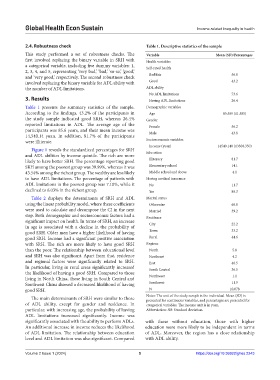
            Table  1 presents the summary statistics of the sample.   Demographic variables
            According to the findings, 43.2% of the participants in   Age                       85.589 (11.585)
            the study sample indicated good SRH, whereas 26.4%   Gender
            reported limitations in ADL. The average age of the   Female                            56.2
            participants was 85.6 years, and their mean income was   Male                           43.8
            14,540.14 yuan. In addition, 81.7% of the participants
            were illiterate.                                   Socioeconomic variables
                                                                Income (yuan)                 14540.140 (13300.350)
              Figure 1 reveals the standardized percentages for SRH
            and ADL abilities by income quintile. The rich are more   Education
            likely to have better SRH. The percentage reporting good   Illiteracy                   81.7
            SRH among the poorest group was 39.99%, whereas it was   Elementary school              14.1
            43.54% among the richest group. The wealthy are less likely   Middle school and above   4.1
            to have ADL limitations. The percentage of patients with   Having medical insurance
            ADL limitations in the poorest group was 7.10%, while it   No                           11.7
            declined to 6.03% in the richest group.             Yes                                 88.3
              Table  2 displays the determinants of SRH and ADL   Marital status
            using the linear probability model, where these coefficients   Otherwise                60.8
            were used to calculate and decompose the CI in the next   Married                       39.2
            step. Both demographic and socioeconomic factors had a   Residence
            significant impact on health. In terms of SRH, an increase
            in age is associated with a decline in the probability of   City                        22.2
            good SRH. Older men have a higher likelihood of having   Town                           33.2
            good SRH. Income had a significant positive association   Rural                         44.6
            with SRH. The rich are more likely to have good SRH   Regions
            than the poor. The relationship between educational level   North                       5.8
            and SRH was also significant. Apart from that, residence   Northeast                    4.2
            and regional factors were significantly related to SRH.   East                          40.5
            In particular, living in rural areas significantly increased   South Central            36.5
            the likelihood of having a good SRH. Compared to those
            living in North China, those living in South Central and   Northwest                    1.1
            Southwest China showed a decreased likelihood of having   Southwest                     11.9
            good SRH.                                           N                                  10,078
              The main determinants of SRH were similar to those   Notes: The unit of the study sample is the individual. Mean (SD) is
                                                               presented for continuous variables, and percentages are presented for
            of ADL ability, except for gender and residence. In   categorical variables. The income unit is in yuan.
            particular, with increasing age, the probability of having   Abbreviation: SD: Standard deviation.
            ADL limitations increased significantly. Income was
            significantly associated with the ability to perform ADLs.   with those without education, those with higher
            An additional increase in income reduces the likelihood   education were more likely to be independent in terms
            of ADL limitation. The relationship between education   of ADL. Moreover, the region has a close relationship
            level and ADL limitation was also significant. Compared   with ADL ability.


            Volume 2 Issue 1 (2024)                         5                        https://doi.org/10.36922/ghes.2243

