


Page 170 - GHES-2-2
P. 170
Global Health Econ Sustain                                         An analysis of national economic resilience


            Q4 2019 to 2.45% in Q1 2020. This uptick can be attributed
            to their primary clientele – small and microenterprises,
            which  were  disproportionately  affected  by the epidemic.
            Conversely, the other three bank types, typically averse
            to lending to higher-risk small and micro enterprises,
            maintained higher asset quality and were less affected by
            the epidemic. However, as the epidemic became gradually
            controlled and the businesses resumed normal operations,
            the NPL rate began to decrease, stabilizing after Q3 2020.
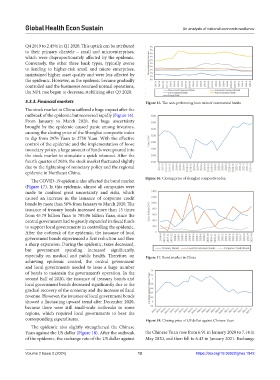
            5.3.3. Financial markets                           Figure 15. The non-performing loan ratio of commercial banks
            The stock market in China suffered a huge impact after the
            outbreak of the epidemic but recovered rapidly (Figure 16).
            From January to March 2020, the huge uncertainty
            brought by the epidemic caused panic among investors,
            causing the closing price of the Shanghai composite index
            to dip from 2976 Yuan to 2750 Yuan. With the effective
            control of the epidemic and the implementation of loose
            monetary policy, a large amount of funds were poured into
            the stock market to stimulate a quick rebound. After the
            fourth quarter of 2020, the stock market fluctuated slightly
            due to the tightening of monetary policy and the regional
            epidemic in Northeast China.
                                                               Figure 16. Closing price of shanghai composite index
              The COVID-19 epidemic also affected the bond market
            (Figure 17). In this epidemic, almost all companies were
            made to confront great uncertainty and risks, which
            caused an increase in the issuance of corporate credit
            bonds by more than 50% from January to March 2020. The
            issuance of treasury bonds increased more than 15 times
            from 45.79 billion Yuan to 785.06 billion Yuan, since the
            central government had to greatly expanded its fiscal funds
            to support local governments in controlling the epidemic.
            After the outbreak of the epidemic, the issuance of local
            government bonds experienced a first reduction and then
            a sharp expansion. During the epidemic, taxes decreased,
            but government spending increased significantly,
            especially on medical and public health. Therefore, on   Figure 17. Bond market in China
            achieving epidemic control, the central government
            and local governments needed to issue a large number
            of bonds to maintain the government’s operation. In the
            second half of 2020, the issuance of treasury bonds and
            local government bonds decreased significantly due to the
            gradual recovery of the economy and the increase of fiscal
            revenue. However, the issuance of local government bonds
            showed a fluctuating upward trend after December 2020,
            because there were still small-scale outbreaks in some
            regions, which required local governments to bear the
            corresponding expenditures.                        Figure 18. Closing price of US dollar against Chinese Yuan
              The epidemic also slightly strengthened the Chinese
            Yuan against the US dollar (Figure 18). After the outbreak   the Chinese Yuan rose from 6.91 in January 2020 to 7.14 in
            of the epidemic, the exchange rate of the US dollar against   May 2020, and then fell to 6.43 in January 2021. Exchange


            Volume 2 Issue 2 (2024)                         12                       https://doi.org/10.36922/ghes.1842

