


Page 165 - GHES-2-2
P. 165
Global Health Econ Sustain                                         An analysis of national economic resilience


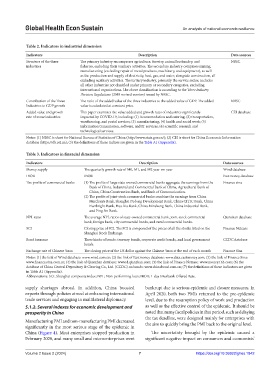
            Table 2. Indicators in industrial dimension
            Indicators                                      Description                            Data sources
            Structure of the three   The primary industry encompasses agriculture, forestry, animal husbandry, and   NBSC
            industries             fisheries, excluding their auxiliary activities. The secondary industry comprises mining,
                                   manufacturing (excluding repair of metal products, machinery, and equipment), as well
                                   as the production and supply of electricity, heat, gas, and water, alongside construction, all
                                   excluding auxiliary activities. The tertiary industry, primarily the service sector, includes
                                   all other industries not classified under primary or secondary categories, excluding
                                   international organizations. The above classification is according to the Three Industry
                                   Division Regulations (2018 revised version) issued by NBSC.
            Contribution of the Three   The ratio of the added value of the three industries to the added value of GDP. The added   NBSC
            Industries to GDP growth  value is calculated at constant price.
            Added value and growth   This paper examines the value added and growth rates of industries significantly   CEI database
            rate of some industries  impacted by COVID-19, including: (1) Accommodation and catering; (2) transportation,
                                   warehousing, and postal services; (3) manufacturing; (4) health and social work; (5)
                                   information transmission, software, and IT services; (6) scientific research and
                                   technological services.
            Notes: (1) NBSC is short for National Bureau of Statistics of China (http://www.stats.gov.cn/); (2) CEI is short for China Economic Information
            database (https://db.cei.cn); (3) the definitions of these indices are given in the Table A1 (Appendix).

            Table 3. Indicators in financial dimension

            Indicators                                      Description                         Data sources
            Money supply             The quarterly growth rate of M0, M1, and M2 year-on-year   Wind database
            IBOR                     IBOR                                                       Eastmoney database
            The profits of commercial banks  (1)  The profits of large state-owned commercial banks aggregate the earnings from the   Finance sina
                                       Bank of China, Industrial and Commercial Bank of China, Agricultural Bank of
                                       China, China Construction Bank, and Bank of Communication.
                                     (2)  The profits of joint-stock commercial banks combine the earnings from China
                                       Merchants Bank, Shanghai Pudong Development Bank, China CITIC Bank, China
                                       Everbright Bank, Hua Xia Bank, China Minsheng Bank, China Industrial Bank,
                                       and Ping An Bank.
            NPL ratio                The average NPL ratios of state-owned commercial bank, joint-stock commercial   Qianzhan database
                                     bank, foreign bank, city commercial banks, and rural commercial banks.
            SCI                      Closing price of SCI. The SCI is composed of the prices of all the stocks listed on the   Finance Netease
                                     Shanghai Stock Exchange.
            Bond issuance            Three kinds of bonds: treasury bonds, corporate credit bonds, and local government   CCDC database
                                     bonds.
            Exchange rate of Chinese Yuan  The closing price of the US dollar against the Chinese Yuan at the end of each month  Finance Sina
            Notes: (1) the link of Wind database: www.wind.com.cn; (2) the link of Eastmoney database: www.data.eastmoney.com; (3) the link of Finance Sina:
            www.finance.sina.com.cn; (4) the link of Qianzhan database: www.d.qianzhan.com; (5) the link of Finance Netease: www.money.163.com; (6) the
            database of China Central Depository & Clearing Co., Ltd. (CCDC) on bonds: www.chinabond.com.cn; (7) the definitions of these indicators are given
            in Table A1 (Appendix).
            Abbreviations: SCI: Shanghai composite index; NPL: Non-performing loan; IBOR: 1-day Interbank Offered Rate.

            supply shortages abroad. In addition, China boosted   bankrupt due to serious epidemic and closure measures. In
            exports through policies aimed at enhancing international   April 2020, both two PMIs returned to the pre-epidemic
            trade services and engaging in multilateral diplomacy.  level, due to the resumption policy of work and production
            5.1.2. Several indexes for economic development and   as well as the effective control of the epidemic. It should be
            prosperity in China                                noted that many fiscal policies in that period, such as delaying
                                                               the tax deadline, were designed mainly for enterprises with
            Manufacturing PMI and non-manufacturing PMI decreased   the aim to quickly bring the PMI back to the original level.
            significantly in the most serious stage of the epidemic in
            China (Figure 4). Most enterprises stopped production in   The uncertainty brought by the epidemic caused a
            February 2020, and many small and microenterprises went   significant negative impact on consumers and economists’


            Volume 2 Issue 2 (2024)                         7                        https://doi.org/10.36922/ghes.1842

