


Page 168 - GHES-2-2
P. 168
Global Health Econ Sustain                                         An analysis of national economic resilience


            operations except for those involved in transporting   and  emerging  technologies  were  applied  to  the  market
            basic living materials. At the same time, almost all   during the epidemic, unleashing the development
            transportation and postal orders were suspended, resulting   potential of this industry. For examples, the QR code and
            in a large backlog of goods. Therefore, after the epidemic   artificial intelligence technology were applied to epidemic
            was controlled and the closure measures were lifted, there   prevention and  control; the  unmanned aerial vehicles
            was a huge rebound in the fourth quarter of 2020. Finally,   were used to transport goods without touching each other.
            the year-on-year growth rate returned to its original level   Despite the controversy surrounding the application of
            in the third quarter of 2021.                      these emerging technologies, it is undeniable that these
              The COVID-19 epidemic also delivered a huge blow   technologies have brought tremendous convenience to
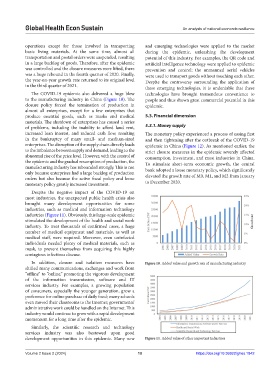
            to the manufacturing industry in China (Figure  10). The   people and thus shown great commercial potential in this
            closure  policy  forced  the  termination  of  production  in   epidemic.
            almost all enterprises,  except  for  a few enterprises that
            produce essential goods, such as masks and medical   5.3. Financial dimension
            materials. The shutdown of enterprises has caused a series
            of problems, including the inability to afford land rent,   5.3.1. Money supply
            increased loan interest, and reduced cash flow, resulting   The monetary policy experienced a process of easing first
            in the bankruptcy of many small-  and medium-sized   and then tightening after the outbreak of the COVID-19
            enterprises. The disruption of the supply chain directly leads   epidemic in China (Figure 12). As mentioned earlier, the
            to the imbalance between supply and demand, leading to the   strict closure measures in the epidemic severely affected
            abnormal rise of the price level. However, with the control of   consumption, investment, and most industries in China.
            the epidemic and the gradual resumption of production, the   To stimulate short-term economic growth, the central
            manufacturing industry has rebounded strongly. This is not   bank adopted a loose monetary policy, which significantly
            only because enterprises had a large backlog of production   elevated the growth rate of M0, M1, and M2 from January
            orders but also because the active fiscal policy and loose
            monetary policy greatly increased investment.      to December 2020.
              Despite the negative impact of the COVID-19 on
            most industries, the unexpected public health crisis also
            brought many development opportunities for some
            industries, such as medical and information technology
            industries (Figure 11). Obviously, this large-scale epidemic
            stimulated the development of the health and social work
            industry. To treat thousands of confirmed cases, a huge
            number of medical equipment and materials, as well as
            medical staff, were required. Moreover, even uninfected
            individuals  needed  plenty  of  medical  materials,  such  as
            mask, to prevent themselves from acquiring this highly
            contagious infectious disease.
              In addition, closure and isolation measures have   Figure 10. Added value and growth rate of manufacturing industry
            shifted many communications, exchanges and work from
            “offline” to “online,” promoting the vigorous development
            of the information transmission, software and IT
            services industry. For examples, a growing population
            of consumers, especially the younger generation, grow a
            preference for online purchase of daily food; many schools
            even moved their classrooms to the Internet; governments’
            administrative work could be handled on the Internet. This
            industry would continue to grow with a rapid development
            momentum for a long time after the epidemic.
              Similarly, the scientific research and technology
            services industry was  also  bestowed  upon good
            development opportunities  in this  epidemic.  Many new   Figure 11. Added value of other important industries


            Volume 2 Issue 2 (2024)                         10                       https://doi.org/10.36922/ghes.1842

