


Page 169 - GHES-2-2
P. 169
Global Health Econ Sustain                                         An analysis of national economic resilience


              As the quarterly GDP growth rate returned to positive,
            the central bank slightly tightened monetary policy to
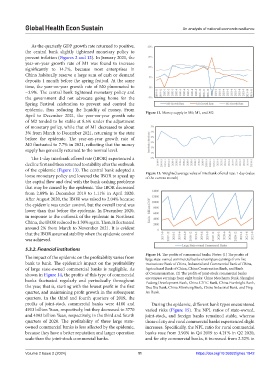
            prevent inflation (Figures 2 and 12). In January 2021, the
            year-on-year growth rate of M1 was found to increase
            significantly to 14.7%, because most enterprises in
            China habitually reserve a large sum of cash or demand
            deposits 1 month before the spring festival. At the same
            time, the year-on-year growth rate of M0 plummeted to
            −3.9%. The central bank tightened monetary policy and
            the government did not advocate going home for the
            Spring Festival celebration to prevent and control the
            epidemic, thus reducing the liquidity of money. From
            April to December 2021, the year-on-year growth rate   Figure 12. Money supply in M0, M1, and M2
            of M2 tended to be stable at 8.5% under the adjustment
            of monetary policy, while that of M1 decreased to about
            3% from March to December 2021, returning to the state
            before the epidemic. The year-on-year growth rate of
            M0 fluctuated to 7.7% in 2021, reflecting that the money
            supply has generally returned to the normal level.
              The 1-day interbank offered rate (IBOR) experienced a
            decline first and then returned to stability after the outbreak
            of the epidemic (Figure 13). The central bank adopted a
            loose monetary policy and lowered the IBOR to speed up   Figure 13. Weighted average value of interbank offered rate: 1-day (value
                                                               of the current month)
            the capital flow and deal with the bank cashing problems
            that may be caused by the epidemic. The IBOR decreased
            from 2.09% in December 2019 to 1.11% in April 2020.
            After August 2020, the IBOR was raised to 2.04% because
            the epidemic was under control, but the overall trend was
            lower than that before the epidemic. In December 2020,
            in response to the outbreak of the epidemic in Northeast
            China, the IBOR reduced to 1.30% again. Then, it fluctuated
            around 2% from March to November 2021. It is evident
            that the IBOR assumed stability when the epidemic control
            was achieved.
            5.3.2. Financial institutions
                                                               Figure 14. The profits of commercial banks. Notes: (1) The profits of
            The impact of the epidemic on the profitability varies from   large state-owned commercial banks encompass earnings from five
            bank to bank. The epidemic’s impact on the profitability   institutions: Bank of China, Industrial and Commercial Bank of China,
            of large state-owned commercial banks is negligible. As   Agricultural Bank of China, China Construction Bank, and Bank
            shown in Figure 14, the profits of this type of commercial   of Communication. (2) The profits of joint-stock commercial banks
            banks fluctuated regularly and periodically throughout   encompass earnings from eight banks: China Merchants Bank, Shanghai
                                                               Pudong Development Bank, China CITIC Bank, China Everbright Bank,
            the year, that is, starting with the lowest profit in the first   Hua Xia Bank, China Minsheng Bank, China Industrial Bank, and Ping
            quarter, and maintaining profit growth in the subsequent   An Bank.
            quarters. In the third and fourth quarters of 2019, the
            profits of joint-stock commercial banks were 4100 and   During the epidemic, different bank types encountered
            4913 billion Yuan, respectively, but they decreased to 3770   varied risks (Figure 15). The NPL ratios of state-owned,
            and 4303 billion Yuan, respectively, in the third and fourth   joint-stock, and foreign banks remained stable, whereas
            quarters of 2020. The profitability of these large state-  those of city and rural commercial banks experienced slight
            owned commercial banks is less affected by the epidemic,   increases. Specifically, the NPL ratio for rural commercial
            because they have a better reputation and larger operation   banks rose from 3.90% in Q4 2019 to 4.21% in Q2 2020,
            scale than the joint-stock commercial banks.       and for city commercial banks, it increased from 2.32% in


            Volume 2 Issue 2 (2024)                         11                       https://doi.org/10.36922/ghes.1842

