


Page 167 - GHES-2-2
P. 167
Global Health Econ Sustain                                         An analysis of national economic resilience


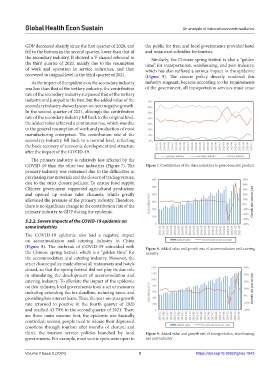
            GDP decreased sharply since the first quarter of 2020, and   the public for free, and local governments provided hotel
            fell to the bottom in the second quarter, lower than that of   and restaurant subsidies for tourists.
            the secondary industry. It showed a V-shaped rebound in   Similarly, the Chinese spring festival is also a “golden
            the third quarter of 2020, mainly due to the resumption   time” for transportation, warehousing, and post industry,
            of work and operation in service industries, and then   which has also suffered a serious impact in the epidemic
            recovered to original level in the third quarter of 2021.  (Figure  9).  The  closure  policy  directly  rendered  this
              As the impact of the epidemic on the secondary industry   industry stagnant, because according to the requirements
            was less than that of the tertiary industry, the contribution   of the government, all transportation services must cease
            rate of the secondary industry surpassed that of the tertiary
            industry and jumped to the first, but the added value of the
            secondary industry showed a year-on-year negative growth.
            In the second quarter of 2021, although the contribution
            rate of the secondary industry fell back to the original level,
            the added value achieved a continuous rise, which was due
            to the general resumption of work and production of most
            manufacturing enterprises.  The contribution  rate of  the
            secondary industry fell back to a normal level, reflecting
            the basic recovery of economic development and structure
            after the impact of the COVID-19.
              The primary industry is relatively less affected by the
            COVID-19 than the other two industries (Figure 7). The   Figure 7. Contribution of the three industries to gross domestic product
            primary industry was restrained due to the difficulties in
            purchasing raw materials and the closure of trading venues,
            due to the strict closure policies. To ensure food supply,
            Chinese government supported agricultural production
            and opened up online sales channels, which greatly
            alleviated the pressure of the primary industry. Therefore,
            there is no significant change in the contribution rate of the
            primary industry to GDP during the epidemic.

            5.2.2. Severe impacts of the COVID-19 epidemic on
            some industries
            The COVID-19 epidemic also had a negative impact
            on accommodation and catering industry in China
            (Figure  8). The outbreak of COVID-19 coincided with   Figure 8. Added value and growth rate of accommodation and catering
            the Chinese spring festival, which is a “golden time” for   industry
            the accommodation and catering industry. However, the
            strict closure policy made almost all restaurants and hotels
            closed, so that the spring festival did not play its due role
            in stimulating the development of accommodation and
            catering industry. To alleviate the impact of the epidemic
            on this industry, local governments took a set of measures
            including extending the tax deadline, reducing taxes, and
            providing low interest loans. Thus, the year-on-year growth
            rate returned to positive in the fourth quarter of 2020
            and reached 43.70% in the second quarter of 2021. There
            are three main reasons: first, the epidemic was basically
            controlled; second, people need to release their depressed
            emotions  through tourism after  months of closure; and
            third, the tourism service policies launched by local   Figure 9. Added value and growth rate of transportation, warehousing,
            governments. For example, most scenic spots were open to   and post industry


            Volume 2 Issue 2 (2024)                         9                        https://doi.org/10.36922/ghes.1842

